eMedicine Journal
>
Pediatrics
>
Infectious Diseases
Hepatitis A
Synonyms, Key Words, and Related Terms: hepatitis A, hepatitis A virus, HAV, viral hepatitis, catarrhal jaundice, epidemic jaundice, infectious hepatitis, viral hepatitis type A, virus A hepatitis, Picornaviridae, picornavirus
|
|
|
 | AUTHOR INFORMATION
| Section 1 of 10  |
Authored by Nicholas John Bennett, MBBCh, PhD, Staff Physician, Department of Pediatrics, State University of New York Upstate Medical University
Coauthored by Joseph Domachowske, MD, Associate Professor, Department of Pediatrics, Division of Infectious Diseases, State University of New York-Upstate Medical University; Lisa C Turner, MD, Clinical Instructor, Departments of Pediatrics and Communicable Diseases, University of Michigan Medical Center
Nicholas John Bennett, MBBCh, PhD, is a member of the following medical societies:
American Academy of Pediatrics
Edited by Rosemary Johann-Liang, MD, Medical Officer, Infectious Diseases and Pediatrics, Division of Special Pathogens and Immunological Drug Products, Center for Drug Evaluation and Research, Food and Drug Administration; Mary L Windle, PharmD, Adjunct Assistant Professor, University of Nebraska Medical Center College of Pharmacy, Pharmacy Editor, eMedicine.com, Inc;
Leslie L Barton, MD, Professor, Program Director, Department of Pediatrics, University of Arizona School of Medicine;
Robert W Tolan, Jr, MD, Chief of Allergy, Immunology and Infectious Diseases, The Children's Hospital at St Peter's University Hospital, Clinical Associate Professor of Pediatrics, Drexel University College of Medicine;
and Russell W Steele, MD, Professor and Vice Chairman, Department of Pediatrics, Head, Division of Infectious Diseases, Louisiana State University Health Sciences Center
eMedicine Journal, July 14 2006, VOLUME 7,
Number 7
 | INTRODUCTION
| Section 2 of 10  |
Background: The earliest description of an illness consistent with viral hepatitis dates back to the second century. During the centuries that followed, epidemics of jaundice were reported, and outbreaks plagued military campaigns, both ancient and modern. In the 1920s, a viral etiology was suggested for what was then known as infectious hepatitis. Various viral agents were isolated from urine, blood, and stool from patients with hepatitis in the early half of the 20th century, but the 27 nm particles of hepatitis A virus (HAV) were not described until 1973; this finding led to the development of serologic testing and, more recently, molecular techniques, such as polymerase chain reaction (PCR). This resulted in greater knowledge regarding the epidemiology, transmission, and infectivity of HAV, as well as the development of prevention measures, including active and passive immunization.
Pathophysiology: HAV infection is transmitted via the fecal-oral route and leads to hepatic injury. The entire liver exhibits necrosis, which is most marked in the centrilobular areas, as well as increased cellularity in the portal areas. The regional lymph nodes and spleen may become enlarged. Liver injury is represented in 3 ways:
- Direct cellular injury that elevates serum liver enzyme levels
- Cholestasis that causes jaundice and hyperbilirubinemia
- Inadequate liver function that lowers serum albumin levels and prolongs the prothrombin time (PT)
Frequency:
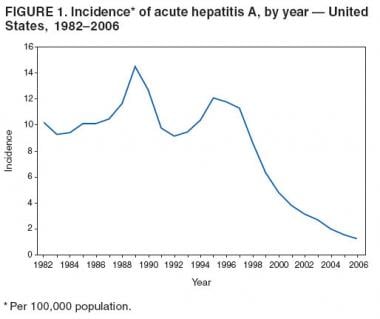
- In the US: In 2004, the national annual incidence in the United States was 1.9 per 100,000. Nearly one third of adults have serologic evidence of prior HAV infection. Higher rates are associated with lower socioeconomic status, crowding, and poor sanitation. Outbreaks may occur in association with poor food hygiene or undercooked food.
- Internationally: In developing countries, infection is highly endemic; nearly 100% of the population has serologic evidence of past HAV disease during childhood.
Mortality/Morbidity:
- In most patients, HAV infection is self-limited, and complete recovery occurs. In fact, many cases are asymptomatic.
- A chronic carrier state is not seen with HAV infection.
- Fulminant hepatitis due to HAV is rare and has a case fatality rate of 0.4%.
Race: Prior to targeted vaccination programs, certain well-defined populations were considered high-risk groups: Native Americans, Alaskan natives, and some Hispanic people. Epidemics occurred in these groups every 5-10 years, as susceptible people entered or were born into the population. In addition, overall rates of infection in nonepidemic years were also greater in these populations than in the United States as a whole.
Since 2003, racial and ethnic differences have virtually disappeared. For example, a nearly 99% decrease was noted in HAV incidence among Native Americans due to a widespread targeted vaccination campaign among the high-risk groups.
Sex:
- HAV infection has no sex predilection.
- Homosexual males may have a higher risk of infection than heterosexual males.
Age:
- In the United States, prior to targeted vaccination programs, the highest rate of infection occurred in children aged 5-14 years. In more recent years, up to 80% of infections have been in adults.
- Interestingly, the classic symptoms of hepatitis are less likely in younger patients. Young children, especially those younger than 5 years, may be asymptomatic or have anicteric illness that appears to be a nonspecific viral infection.
History:
- The incubation period from the time of exposure to the appearance of symptoms is around 28 days (range 2 wk to 6 mo).
- The patient's initial symptoms during the prodromal period include low-grade fever, nausea, vomiting, decreased appetite, and abdominal pain.
- Older children and adults are more likely to report pain in the right upper quadrant.
- Diarrhea may occur in young children, whereas constipation is more common in adults.
- If present, jaundice, dark urine, and light-colored stool develop several days to a week after the onset of systemic symptoms. Anicteric infections are common in young children.
Physical:
- The general appearance is that of mild-to-moderate illness. A patient who appears severely ill is likely to have hepatitis of another cause or an atypical course.
- Mild hepatomegaly and right upper quadrant tenderness may be present.
- Clinical jaundice is present in two thirds of symptomatic patients.
- Splenomegaly may occur in 10-20% of patients.
Causes:
- HAV is a positive-sense, single-stranded, nonenveloped RNA virus that belongs to the picornavirus family and Hepadnavirus genus.
- Transmission is via the fecal-oral route, and viral replication occurs in the liver. HAV is then excreted into the bile. Its concentration is highest in the stool, especially during the 2 weeks prior to the onset of jaundice. This correlates with the period of peak infectivity. Children and adults can be assumed to be noninfectious one week after the appearance of jaundice.
- Common-source outbreaks from contaminated food or water may occur.
- HAV is concentrated in filter-feeding shellfish, which may thrive close to sewage outlets, and widespread outbreaks can occur from a single contaminated source, such as uncooked vegetables, which are then disseminated to restaurants or grocery stores.
- Statistically, eating out is actually less risky than home cooking.
- Childcare centers may be sources of outbreaks from contaminated changing tables. These outbreaks may not be identified until an adult contact has a recognizable HAV infection because young children are often asymptomatic or have anicteric illnesses.
- Nosocomial outbreaks have occurred because of HAV shedding.
- Outbreaks of HAV infection have been increasingly reported among illicit drug users.
- International travel is another risk factor for HAV infection.
- HAV spread from nonhuman primates to humans has been reported.
- HAV vertical transmission (mother to neonate) and transmission by means of blood transfusion are extremely rare.
- Sexual transmission is possible, especially between homosexual men.
 | DIFFERENTIALS
| Section 4 of 10  |
Enteroviral Infections
Gallbladder Disease
Gastroenteritis
Hepatitis B
Hepatitis C
Other Problems to be Considered:
Drug-induced hepatotoxicity
Hepatitis E
Lab Studies:
- Liver function tests
- Liver inflammation during HAV infection can be identified by elevations in alanine aminotransferase (ALT), aspartate aminotransferase (AST), and gamma-glutamyltranspeptidase (GGTP) levels. Increases in ALT and AST levels are seen most consistently, and the values are usually 4-100 times the normal levels. Elevations in ALT and AST levels may precede the onset of symptoms by a week or more and usually peak within 3-10 days after onset of clinical illness.
- Serum bilirubin levels, although elevated, usually remain below 10 mg/dL and peak after 1-2 weeks of illness.
- Prolongation of the PT and a significant decrease in the albumin level suggest a more severe course.
- Anti-HAV antibody tests
- Specific antibody tests for HAV confirm infection.
- Anti-HAV immunoglobulin M (IgM) is present at the onset of symptoms, and its level remains high for 4-8 weeks. It usually disappears by 4-6 months, but, occasionally, it persists longer.
- Anti-HAV immunoglobulin G (IgG) becomes detectable shortly after the IgM titer appears and usually increases as the IgM level decreases.
- IgG persists for life and provides ongoing immunity against reinfection.
Imaging Studies:
- Imaging studies are generally not necessary. The history and physical examination and laboratory findings are used to establish the diagnosis in most cases of HAV.
- Ultrasonography of the liver may be helpful when cholelithiasis is a consideration.
Histologic Findings: Histologic findings are similar to those in other forms of acute viral hepatitis and include inflammatory cell infiltration, hepatocellular necrosis, and liver cell regeneration. Liver biopsy is not indicated because of the self-limited nature of HAV and lack of chronic infection.
 | TREATMENT
| Section 6 of 10  |
Medical Care:
- Treatment is supportive because no specific therapy for the virus exists. The investigational antienteroviral drug Pleconaril (Disoxaril, made by ViroPharma) has no activity against HAV.
- Hospitalization is indicated for patients with significant dehydration due to vomiting or those with fulminant hepatitis.
- Medications that have known liver toxicity should be avoided.
Consultations:
- Consultation with a subspecialist is generally not required.
- Fulminant hepatitis warrants care by a pediatric gastroenterologist and, possibly, an intensive care specialist.
Diet:
- No specific dietary changes are needed.
- In euvolemic patients with vomiting (but without dehydration that requires intravenous fluid therapy), appropriate intake of oral fluid is recommended, as with other viral illnesses.
Activity:
- Patients should not return to school or work for 1 week after the onset of illness.
- Hospitalized patients who use diapers or those who are incontinent should have contact isolation for 1 week after the onset of illness.
- Activity can otherwise be resumed, as tolerated.
 | MEDICATION
| Section 7 of 10  |
No specific medications are indicated.
 | FOLLOW-UP
| Section 8 of 10  |
Further Inpatient Care:
- Inpatient care is not needed for most patients with HAV infection.
- Some patients may require hospitalization for intravenous rehydration. Once emesis subsides and the patient can tolerate oral fluids, discharge is appropriate.
Further Outpatient Care:
- Follow-up liver enzyme studies should be performed at monthly intervals until levels normalize. If elevations persist longer than 3 months, complications or additional diagnoses should be considered.
Transfer:
- In the rare case of fulminant hepatitis, transfer to a facility with pediatric subspecialty care is indicated.
Deterrence/Prevention:
- General prevention measures consist of good personal hygiene, hand washing, ingestion of safe drinking water, and proper sanitation.
- Prevention specific to hepatitis A infection includes the use of HAV immune globulin (IG) and HAV vaccine.
- IG is given as an intramuscular injection of 0.02 mL/kg. It is 80-90% effective in preventing HAV infection by means of passive immunity.
- HAV vaccine is currently licensed for use in children aged 12 months or older. One dose of vaccine leads to seroconversion in 88% of adult patients by 15 days and in 99% of adult patients by 1 month. When followed with a second dose at 6 months, the vaccine leads to 100% seroconversion.
- The Advisory Committee on Immunization Practices (in the United States) has recommended universal immunization in all children older than one year (the lower limit of the approved age range) and catch-up immunization in those who have not been vaccinated.
- Specific measures to prevent HAV can be divided into 2 groups: pre-exposure prophylaxis and postexposure prophylaxis.
- Pre-exposure prophylaxis with HAV vaccine is recommended for persons aged 1 year or older who are traveling to countries where HAV infection is endemic. If the trip is shorter than 2 weeks, or if the patient is younger than 1 years, IG should be given. If the trip is longer than 3 months, a larger dose of IG (0.06 mL/kg) is needed for those who cannot receive the vaccine. Others who should receive the vaccine include children aged 12-35 months, patients with chronic liver disease, homosexual or bisexual men, users of injectable illicit drugs, and those with a high occupational risk (those who work with nonhuman primates and HAV laboratory workers).
- Postexposure prophylaxis consists of the administration of IG to contacts as soon as possible, but not longer then 2 weeks after exposure. Candidates for postexposure prophylaxis include the following: household and sexual contacts of infected patients; contacts in childcare centers during outbreaks; and, if the patient is a food handler, others who work at the same establishment.
- The use of contact precautions is recommended for hospitalized patients for 1 week after the onset of symptoms.
Complications:
- Complications are few.
- Fulminant hepatitis with massive hepatic necrosis and liver failure due to HAV infection is rare.
- Cholestatic hepatitis occurs in a small percentage of patients. It is identified by persistent hyperbilirubinemia, pruritus, and constitutional symptoms that last for 12-16 weeks in the absence of biliary obstruction on sonograms.
Prognosis:
- The prognosis is excellent.
- Relapsing HAV occurs in approximately 10% of patients 1-4 months after the initial episode and results in full recovery.
- Except in rare cases of fulminant hepatitis, pediatric patients recover without sequelae.
- Chronic active hepatitis, which can be seen in hepatitis B or hepatitis C infection, does not occur in HAV infection.
Patient Education:
- Patients and parents should be educated regarding the transmission of HAV and proper hygiene.
- Indications for postexposure prophylaxis should be explained, and affected individuals should be identified and treated appropriately. Local and state health departments are instrumental in epidemiologic identification of the appropriate contacts who need postexposure prophylaxis.
- Physicians should be prepared to explain transmission and prevention issues to the staff at the patient's school and childcare center. This can help identify individuals who may need prophylaxis, as well as alleviate unnecessary worries for those who are not at risk.
- For excellent patient education resources, visit eMedicine's Hepatitis Center and Liver, Gallbladder, and Pancreas Center. Also, see eMedicine's patient education article, Hepatitis A.
 | TEST QUESTIONS
| Section 9 of 10  |
CME Question 1: A 10-year-old girl presents with low-grade fever, nausea, mild abdominal pain, and jaundice. Physical examination reveals a mildly ill child with right upper quadrant (RUQ) tenderness and mild hepatomegaly. The skin and sclerae are icteric. Which of the following laboratory results is least likely to be helpful in diagnosing hepatitis A viral (HAV) infection?
A: Aspartate aminotransferase (AST) and alanine aminotransferase (ALT) levels
B: Bilirubin level
C: Anti-HAV immunoglobulin M (IgM) and immunoglobulin G (IgG) levels
D: Erythrocyte sedimentation rate
E: Prothrombin time
The correct answer is D: The erythrocyte sedimentation rate is not necessary or helpful in diagnosing HAV infection. Liver inflammation during HAV infection can be identified by elevations in ALT, AST, and gamma-glutamyltranspeptidase levels. Serum bilirubin levels, although elevated, usually remain below 10 mg/dL and peak after 1-2 weeks of illness. Prolongation of the prothrombin time and a significant decrease in the albumin level suggest a more severe course. Anti-HAV IgM is present at the onset of symptoms, and its level remains high for 4-8 weeks. Anti-HAV IgG becomes detectable shortly after the IgM titer appears and usually increases as the IgM level decreases.
CME Question 2: Hepatitis A viral (HAV) infection is diagnosed in a 10-year-old girl. Which of the following statements should be part of the patient education provided to the family?
A: HAV infection is transmitted via contact with blood or body fluid.
B: All of her classmates should receive immune globulin (IG) therapy.
C: Good hand-washing and hygiene help to prevent further spread of the virus.
D: The patient must remain out of school for 1 month.
E: Her prognosis is poor.
The correct answer is C: HAV is transmitted via the fecal-oral route. Only household or intimate contacts need postexposure prophylaxis when patient is older than the toilet-training age. Exclusion from school need only be for 1 week after onset of illness. Good hygiene is an important prevention measure.
Pearl Question 1 (T/F): Symptoms of hepatitis A viral (HAV) infection differ between young children and adults.
The correct answer is True: Young children, especially those younger than 5 years, may be asymptomatic or have anicteric illness that appears to be a nonspecific viral infection. Interestingly, the younger the patient, the less likely the classic symptoms of hepatitis will be present. Older children and adults are more likely to report pain in the right upper quadrant than younger children. Diarrhea may occur in young children, whereas constipation is more common in adults.
Pearl Question 2 (T/F): In the United States, children aged 5-14 years have the highest rate of hepatitis A viral (HAV) infection.
The correct answer is False: Since the onset of targeted, widespread vaccination in high risk areas and populations, the vast majority of HAV infections (80%) are currently in the adult population.
Pearl Question 3 (T/F): The prognosis of hepatitis A viral (HAV) infection is poor.
The correct answer is False: HAV infection usually is self-limited and has an excellent prognosis. Except in rare cases of fulminant hepatitis, pediatric patients recover without sequelae. Chronic active hepatitis, which can be seen in hepatitis B or hepatitis C infection, does not occur in HAV infection.
Pearl Question 4 (T/F): Hepatitis A viral (HAV) vaccination is indicated for persons younger than 1 year who are traveling to countries with relatively low rates of infection.
The correct answer is False: HAV vaccination is currently recommended for all children aged 1 year and older. HAV vaccine is indicated for persons older than 1 year who are traveling to countries with high rates of infection and for those in high-risk groups (eg, patients with chronic liver disease, homosexual or bisexual men, users of injectable illicit drugs, people who work with nonhuman primates, HAV laboratory workers).
 | BIBLIOGRAPHY
| Section 10 of 10 |
-
AAP: Hepatitis A. In: Red Book: Report of the Committee on Infectious Diseases. American Academy of Pediatrics; 2003: 309-318.
-
Bell BP, Shapiro CN, Margolis HS: Hepatitis A virus. In: Textbook of Pediatric Infectious Diseases. 2004:2069-2086.
-
Black S, Shinefield H, Hansen J, et al: A post-licensure evaluation of the safety of inactivated hepatitis A vaccine (VAQTA, Merck) in children and adults. Vaccine 2004 Jan 26; 22(5-6): 766-72[Medline].
-
CDC: Notice to readers: FDA approval of Havrix (hepatitis A vaccine, inactivated) for persons aged 1-18 years. MMWR December 9, 2005; 54(48): 1235-1236[Full Text].
-
CDC: Notice to readers: FDA approval of VAQTA (hepatitis A vaccine, inactivated) for children aged > 1 year. MMWR October 14, 2005; 54(40): 1026[Full Text].
-
Dmochowski L: Viral type A and type B hepatitis: morphology, biology, immunology and epidemiology--a review. Am J Clin Pathol 1976 May; 65(5 Suppl): 741-86[Medline].
-
Feinstone SM, Kapikian AZ, Purceli RH: Hepatitis A: detection by immune electron microscopy of a viruslike antigen associated with acute illness. Science 1973 Dec 7; 182(116): 1026-8[Medline].
-
Frenck RW: Universal hepatitis A immunization recommendation made by ACIP. AAP News 2005; 26 (12): 1[Full Text].
-
Hadler SC, Webster HM, Erben JJ, et al: Hepatitis A in day-care centers. A community-wide assessment. N Engl J Med 1980 May 29; 302(22): 1222-7[Medline].
-
Jacobs RJ, Greenberg DP, Koff RS, et al: Regional variation in the cost effectiveness of childhood hepatitis A immunization. Pediatr Infect Dis J 2003 Oct; 22(10): 904-14[Medline].
-
Lolekha S, Pratuangtham S, Punpanich W, et al: Immunogenicity and safety of two doses of a paediatric hepatitis A vaccine in thai children: comparison of three vaccination schedules. J Trop Pediatr 2003 Dec; 49(6): 333-9[Medline].
-
Snyder JD, Pickering LK: Hepatitis A through E. In: Nelson Textbook of Pediatrics. 17th edition. 2004:1324-1327.
| NOTE: |
| Medicine is a constantly changing science and not all therapies are clearly established. New research changes drug and treatment therapies daily. The authors, editors, and publisher of this journal have used their best efforts to provide information that is up-to-date and accurate and is generally accepted within medical standards at the time of publication. However, as medical science is constantly changing and human error is always possible, the authors, editors, and publisher or any other party involved with the publication of this article do not warrant the information in this article is accurate or complete, nor are they responsible for omissions or errors in the article or for the results of using this information. The reader should confirm the information in this article from other sources prior to use. In particular, all drug doses, indications, and contraindications should be confirmed in the package insert. FULL DISCLAIMER |
eMedicine Journal, July 14 2006, VOLUME 7,
Number 7
© Copyright 2001, eMedicine.com, Inc.
|
Please email us with any comments you have on our new chapter format.
|