eMedicine Journal
>
Pediatrics
>
Genetics And Metabolic Disease
Wolf-Hirschhorn Syndrome
Synonyms, Key Words, and Related Terms: chromosome 4p deletion syndrome, 4p- syndrome, monosomy 4p syndrome, Wolf syndrome, Pitt-Rogers-Danks syndrome, Wolf-Hirschhorn syndrome, mental retardation, seizures, distinct facial appearance, midline closure defects
|
|
|
 | AUTHOR INFORMATION
| Section 1 of 12  |
Authored by Harold Chen, MD, MS, FAAP, FACMG, Chief, Professor, Department of Pediatrics, Section of Perinatal Genetics, Louisiana State University Medical Center
Harold Chen, MD, MS, FAAP, FACMG, is a member of the following medical societies:
American Academy of Pediatrics,
American College of Medical Genetics,
American Medical Association,
American Society of Human Genetics, and
Teratology Society
Edited by Erawati V Bawle, MD, FAAP, FACMG, Director, Division of Genetic and Metabolic Disorders, Children's Hospital of Michigan; Professor (Clinician-Educator), Department of Pediatrics, Wayne State University School of Medicine; Mary L Windle, PharmD, Adjunct Assistant Professor, University of Nebraska Medical Center College of Pharmacy, Pharmacy Editor, eMedicine.com, Inc;
Robert Anthony Saul, MD, Senior Clinical Geneticist, Greenwood Genetic Center; Clinical Professor, Department of Pediatrics, University of South Carolina;
Paul D Petry, DO, FACOP, FAAP, Clinical Assistant Professor of Pediatrics, University of North Dakota, School of Medicine and Health Sciences; Consulting Staff, Altru Health System;
and Bruce A Buehler, MD, Professor, Department of Pathology and Microbiology, Chairman, Department of Pediatrics, Director, Hattie B Munroe Center for Human Genetics, University of Nebraska Medical Center
eMedicine Journal, December 19 2005, VOLUME 6,
Number 12
 | INTRODUCTION
| Section 2 of 12  |
Background: Wolf-Hirschhorn syndrome was first documented in 1961 by Herbert Cooper and Kurt Hirschhorn. They described a child with midline fusion defects, and subsequent cytogenetic studies revealed a chromosomal deletion of the short arm of chromosome 4. In 1965, back-to-back publications in Humangenetik by Hirschhorn et al and Wolf et al brought the disease to the attention of geneticists and other medical professionals. Numerous cases subsequently were published. Clinical features include mental retardation, seizures, distinct facial appearance, and midline closure defects.
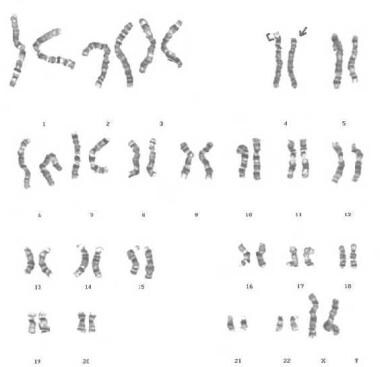
Pathophysiology: Wolf-Hirschhorn syndrome results from the deletion of the distal short arm of chromosome 4. Deletion of the terminal band (4p16.3) is essential for full expression of the phenotype.
A large deletion of several megabases in length, detected easily by conventional chromosome analysis, usually is associated with severe phenotypic expression including multiple malformations. However, a microdeletion of band 4p16.3, detected only by molecular probes, usually is associated with a milder phenotype without malformations.
Most phenotypic manifestations in this syndrome reflect a contiguous gene syndrome, leading to a phenotypic map of chromosome arm 4p. However, similar genetic rearrangements in this syndrome may determine variable phenotypic effects, most likely as a consequence of allelic variation in the homologous 4p region. The former Pitt-Rogers-Danks syndromes, caused by overlapping 4p deletions, now are considered as a part of Wolf-Hirschhorn syndrome.
Frequency:
- In the US: Incidence is estimated at 1 in 50,000 births.
Mortality/Morbidity: Mortality rate is estimated at 34% in the first 2 years of life. However, because many affected children die before the anomaly is diagnosed or suspected, the mortality rate is underestimated. The usual cause of death is a heart defect, aspiration pneumonia, infection, or seizure.
- Prenatal mortality rate of Wolf-Hirschhorn syndrome is not augmented significantly because 4p deletions are not reported as an increase in spontaneous abortions.
- Associated adulthood morbidity includes congenital heart defect; marked growth failure; contracture of hands, wrists, and feet; poor development of secondary sexual characteristics; and severe growth and intellectual handicap.
Race: No ethnic predilection exists.
Sex: Wolf-Hirschhorn syndrome occurs more frequently in females than in males, with a male-to-female ratio of 1:2.
Age: Usually, the condition is detected in the newborn period because of dysmorphic features.
History:
- Pregnancy history
- Intrauterine growth retardation
- Decreased fetal movements
- Hypotrophic placenta
- Developmental history
- Delayed psychomotor development
- Difficulty in ambulation, often with ataxic gait
- Seizures (50%)
- Behavior history
- Stereotypes (holding the hands in front of the face, hand-washing or flapping, patting self on chest, rocking, head-shaking, stretching of legs)
- Absence of speech
- Babbling or guttural sounds, occasionally modulated in a communicative way
- Comprehension limited to simple orders or to a specific context
- Affect disorder that improves over time
- Walking with or without support
- Self-feeding
- Helps in dressing and undressing self
- Improved abilities and adaptation to new situations
- Communicative abilities and verbal comprehension with extension of the gesture repertoire and decreased occurrence of withdrawal and anxiety behaviors
Physical:
- Growth - Severe growth retardation (short stature)
- CNS - Profound mental retardation, microcephaly, seizures, congenital hypotonia with muscle hypotrophy particularly of the lower limbs, hypoplasia of cerebellum, cavum or absent septum pellucidum, agenesis of corpus callosum, hypoplasia or absence of olfactory bulbs and tracts, microgyria, migration defects, hydrocephalus
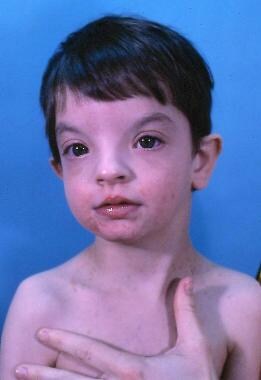
- Skull - Frontal bossing, high frontal hairline, hemangioma over forehead or glabella, scalp defect with or without underlying bony defect
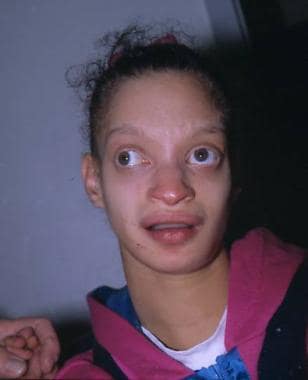
- Face - Characteristic dysmorphic features including prominent glabella, hypertelorism, broad beaked nose, and frontal bossing, collectively described as "Greek warrior helmet" facies
- Eyes - Hypertelorism, down-slanting palpebral fissures, epicanthal folds, strabismus, coloboma, proptosis due to hypoplasia of orbital ridges, ectopic pupils, exotropia, ptosis, microphthalmia, megalocornea, sclerocornea, cataracts, hypoplastic anterior chamber and ciliary body of iris, persistence of lenticular membrane, hypoplastic retina with formation of rosettes, cup-shaped optic discs, congenital nystagmus, Rieger anomaly
- Nose - Broad or beaked nose, nasolacrimal duct stenosis or atresia
- Mouth - Short upper lip, short philtrum, cleft lip or palate, bifid uvula, carplike mouth, micrognathia, retrognathia
- Ears - Low-set ears; large, floppy, or misshapen ears; microtia; preauricular dimples; chronic otitis media with effusion; sensorineural hearing loss
- Cardiovascular - Atrial septal defect, ventricular septal defect, persistent left superior vena cava, valve abnormalities, complex cardiac defects
- Pulmonary - Bilateral bilobed or trilobed lungs, lung hypoplasia secondary to diaphragmatic hernia
- GI - Diastasis recti, umbilical or inguinal hernias, accessory spleens, absent gallbladder, diaphragmatic hernia, intestinal malrotation
- Genitourinary - Hypoplastic kidneys, cystic dysplastic kidneys, unilateral renal agenesis, hydronephrosis, exstrophy of bladder, hypoplastic external genitalia, cryptorchidism and hypospadias in males; hypoplastic müllerian derivatives (ie, agenesis of vagina, cervix or uterus; hypoplastic uterus; ovarian streaks) in females
- Skeletal - Long slender fingers with additional flexion creases, long narrow chest, hypoplastic widely spaced nipples, hypoplasia or duplication of thumbs and great toes, talipes equinovarus, hypoplasia of pubic bones, vertebral and rib anomalies, defective calvaria ossification, scoliosis, kyphosis, osteoporosis, delayed bone maturation, sacral dimple
- Immune system - Infection-prone, immunodeficiency
- Dermatoglyphics - Hypoplastic dermal ridges, transverse palmar creases (25%), excess of digital arches, t or t’
- Fetal phenotype
- Minor anomalies - Scalp defect, hypertelorism usually with a prominent glabella, pulmonary isomerism, common mesentery, hypospadias, sacral dimple
- Major anomalies - Intrauterine growth retardation, microcephaly, cleft palate, corpus callosum agenesis, ventricular septal defect, diaphragmatic hernia, renal hypoplasia
Causes:
- Wolf-Hirschhorn syndrome is caused by a deletion in the terminal band of the short arm of chromosome 4 (band 4p16.3). The cause in 87% of cases is a de novo interstitial deletion of preferential paternal origin. The remaining 13% are due to unbalanced product of a parental chromosomal rearrangement, usually of a reciprocal translocation. The number of translocations may be higher since fluorescence in situ hybridization (FISH) has demonstrated submicroscopic translocations in cytogenetically normal parents and affected offspring.
- Molecular analysis of various patients localized the critical region to an approximate 450-700 kb between D4S168/FGFR3 and D4S166/D4S43. The chromosome band 4p16.3 region also contains a gene called DFNA6 for autosomal dominant nonsyndromic hereditary hearing loss.
- Using genotype-phenotype correlation analysis in 8 informative patients, Zollino et al (2003) characterized the following minimal diagnostic criteria for this condition: presence of typical facial appearance, mental retardation, growth delay, congenital hypotonia, and seizures. They also mapped this basic phenotype outside the currently defined Wolf-Hirschhorn syndrome critical region (WHSCR) and designated a new critical region, WHSCR-2.
 | DIFFERENTIALS
| Section 4 of 12  |
Cri-du-chat Syndrome
Patau Syndrome
Smith-Lemli-Opitz Syndrome
Trisomy 18
Other Problems to be Considered:
Duplication 4p syndrome - Interstitial direct duplication of 4p (4p16.1-4p16.3), large low-set ears, microcephaly, a prominent glabella, broad nasal bridge, bulbous nose (often referred to as box nose), growth deficiency, severe mental retardation, seizures, scoliosis, fifth finger clinodactyly, flexion contractures, hypospadias
Other autosomal monosomy syndromes and trisomy syndromes
Other multiple congenital anomalies and mental retardation syndromes
Pitt-Rogers-Danks syndrome (OMIM #262350): This is a rare disorder, presumed to have autosomal recessive inheritance, that is characterized by prenatal and postnatal growth retardation, microcephaly, characteristic facial appearance, seizures, unusual palmar creases, and developmental delay. Microdeletion of chromosome band 4p16 has been reported.
Proximal 4p syndrome - Deletion of the proximal half of chromosome arm 4p (4p11->4p15), moderate mental deficiency, normal height, short palpebral fissures, abnormal ears, large nose, broad hands, microcephaly, short fingers, congenital heart defects
Seckel syndrome (OMIM #210600) - Also known as bird-headed dwarfism or microcephalic primordial dwarfism type I
Lab Studies:
- Conventional cytogenetic studies
- This is the most common method to detect chromosome arm 4p deletions.
- Small chromosome arm 4p deletions may be missed.
- High-resolution cytogenetic studies
- Smaller deletions of chromosome band 4p16.3 may be detected by this method.
- Very small rearrangements, especially subtle translocation, can be very difficult to detect even with high-resolution chromosome analysis.
- Fluorescence in situ hybridization
- Molecular cytogenetic studies using fluorescence in situ hybridization (FISH) allow the diagnosis to be made in patients with very small deletions or cryptic translocations.
- FISH uses genetic markers that have been precisely localized to the area of interest.
- The absence of signal from either the maternal or paternal allele for the marker is indicative of monosomy for that chromosomal region.
- Commercially, D4S96 or D4Z1 chromosome band 4p16.3-specific probe (Wolf-Hirschhorn region, Vysis, Inc) is available for FISH study.
- Immune workup
- Common variable immunodeficiency
- Immunoglobulin A (IgA) and Immunoglobulin G2 (IgG2) subclass deficiency
- IgA deficiency
- Impaired polysaccharide responsiveness
- Normal T-cell immunity
Imaging Studies:
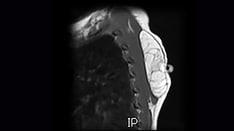
- Radiographs may reveal delayed bone maturation, microcephaly, hypertelorism, micrognathia, anterior fusion of vertebrae, fused ribs, dislocated hips, proximal radioulnar synostosis, and club feet.
- Echocardiography may be helpful in detecting heart defects.
- Renal ultrasonography detects renal anomalies.
- MRI and CT scans may demonstrate underlying brain pathology, including agenesis of corpus callosum and ventriculomegaly.
Other Tests:
- EEG for seizure monitoring
- Swallowing study for feeding difficulty
- Comprehensive audiologic and otologic evaluation to rule out possible hearing impairment
- Ophthalmologic examination
- Developmental testing and referral to early intervention and appropriate school placement
Procedures:
- Gastrostomy may be necessary in infancy to protect the airway of patients with major feeding difficulty.
 | TREATMENT
| Section 6 of 12  |
Medical Care: Medical care is supportive. No treatment exists for the underlying disorder.
- Seizure control
- Multidisciplinary team approach
- Genetic counseling
- Recurrence risk is negligible unless a parent is a translocation carrier.
- Reassessing patients with abnormal phenotypes previously reported as cytogenetically normal is imperative since the precise diagnosis in the propositus has important reproductive implications.
- FISH can demonstrate submicroscopic translocations in cytogenetically normal parents and affected offspring.
Consultations:
- Clinical geneticists
- Developmental pediatricians
- Neurologists
- Cardiologists
- Ophthalmologists
- Orthopedists
- Physical therapists
- Occupational therapists
- Speech language pathologists
- Audiologists
Diet: No special diet is required.
Activity: Activities are limited because of profound mental retardation and physical handicaps.
 | MEDICATION
| Section 7 of 12  |
Medical care is supportive. No medications are used to treat the underlying disorder.
 | FOLLOW-UP
| Section 8 of 12  |
Prognosis:
- Frequent stillbirths, perinatal deaths, and death within the first year
- If patients survive beyond infancy, they have slow but constant progress in development.
Patient Education:
- Up-to-date information about the syndrome should be made available to the families through the following organizations:
 | MISCELLANEOUS
| Section 9 of 12  |
Medical/Legal Pitfalls:
- Failure to identify characteristic symptoms and signs
- Failure to refer to a geneticist for evaluation and genetic counseling
- Failure to request chromosome analysis of clinically diagnosed patients and their parents to rule out familial translocation
- Failure to offer prenatal diagnosis after having an affected child
- It is important to reassess patients with abnormal phenotypes previously reported as cytogenetically normal since the precise diagnosis in the propositus has important reproductive implications.
- Physicians and parents should be aware of the psychomotor potential of the child with Wolf-Hirschhorn syndrome in order to make informed decisions concerning home rearing or institutional placement.
Special Concerns:
- Prenatal diagnosis
- Perform ultrasonography. The distinct phenotype may manifest in utero on ultrasound. Findings include severe intrauterine growth retardation, microcephaly, hypertelorism, usually with prominent glabella, cleft lip and palate, and diaphragmatic hernia. These findings should lead to karyotyping.
- Amniocentesis is routinely performed at 14-16 weeks' gestation and remains the criterion standard by which all other invasive diagnostic tests are compared. Amniocentesis testing for chromosome disorders is 99.5% accurate (missing rare cases of mosaicism and inaccurate results in the presence of maternal cell contamination). The procedure is associated with a small risk of pregnancy loss (about 1 in every 200-300).
- Chorionic villus sampling (CVS) is performed at 10-13 weeks' gestation. Earlier testing of CVS is thought to be associated with a small risk (1 in every 300-1,000) of fetal transverse limb deficiency, small chance of maternal cell contamination, and a 0.5-1% risk of a fetal loss after the procedure. The accuracy (96-98%) is less than that of midtrimester amniocentesis due to confined placental mosaicism and maternal cell contamination.
- Percutaneous umbilical blood sampling (PUBS) is performed for rapid fetal karyotyping. The rate of complications is about 15%, including a 2% rate of fetal death or spontaneous abortion.
 | TEST QUESTIONS
| Section 10 of 12  |
CME Question 1: Which of the following is the major clue for diagnosis of an infant with Wolf-Hirschhorn syndrome?
A: Growth retardation
B: Mental retardation
C: Cleft lip and palate
D: "Greek warrior helmet" facies
E: Seizures
The correct answer is D: Characteristic dysmorphic features of Wolf-Hirschhorn syndrome include prominent glabella, hypertelorism, a broad-beaked nose, and frontal bossing. These are collectively described as “Greek warrior helmet” facies.
CME Question 2: Which one of the following statements is not true regarding Wolf-Hirschhorn syndrome?
A: Deletion of chromosome band 4p16.3 is essential for full expression of the phenotype.
B: Midline fusion defects are present.
C: Prenatal mortality rate is significantly increased.
D: The condition is more frequent in females.
E: De novo interstitial deletion is preferentially paternal in origin.
The correct answer is C: Prenatal mortality rate is not known to be significantly increased because chromosome arm 4p deletions have not been reported to be increased in spontaneous abortions.
Pearl Question 1 (T/F): Cytogenetic technique used to demonstrate submicroscopic translocations in cytogenetically normal parents and affected offspring is fluorescence in situ hybridization (FISH) using genetic markers that have been localized to the locus in question.
The correct answer is True: FISH using genetic markers that have been precisely localized to the Wolf-Hirschhorn syndrome locus may be used. The absence of signal from either the maternal or paternal allele for the marker is indicative of monosomy of chromosome band 4p16.3.
Pearl Question 2 (T/F): The recurrence risk after having a child with Wolf-Hirschhorn syndrome is significantly increased.
The correct answer is False: Recurrence risk is negligible unless a parent is a translocation carrier.
Pearl Question 3 (T/F): A fetus with Wolf-Hirschhorn syndrome may manifest in utero on careful ultrasound examination.
The correct answer is True: The ultrasonographic findings (eg, intrauterine growth retardation, hypertelorism, cleft lip and palate, diaphragmatic hernia) can lead to karyotyping.
Pearl Question 4 (T/F): In a negligible proportion of patients, Wolf-Hirschhorn syndrome is due to unbalanced product of a parental chromosomal rearrangement.
The correct answer is False: About 13% of cases are due to unbalanced product of a parental chromosomal rearrangement, usually of a reciprocal translocation.
 | PICTURES
| Section 11 of 12  |
 | BIBLIOGRAPHY
| Section 12 of 12 |
-
Altherr MR, Wright TJ, Denison K, et al: Delimiting the Wolf-Hirschhorn syndrome critical region to 750 kilobase pairs. Am J Med Genet 1997 Jul 11; 71(1): 47-53[Medline].
-
Battaglia A, Carey JC, Cederholm P, et al: Natural history of Wolf-Hirschhorn syndrome: experience with 15 cases. Pediatrics 1999 Apr; 103(4 Pt 1): 830-6[Medline][Full Text].
-
Battaglia A, Carey JC: Health supervision and anticipatory guidance of individuals with Wolf- Hirschhorn syndrome. Am J Med Genet 1999 Jun 25; 89(2): 111-5[Medline].
-
Cooper H, Hirschhorn K: Apparent deletion of short arms of one chromosome (4 or 5) in a child with defects of midline fusion. Mammalian Chrom Nwsl 1961; 4: 14.
-
Dallapiccola B, Mandich P, Bellone E, et al: Parental origin of chromosome 4p deletion in Wolf-Hirschhorn syndrome. Am J Med Genet 1993 Nov 1; 47(6): 921-4[Medline].
-
Estabrooks LL, Breg WR, Hayden MR, et al: Summary of the 1993 ASHG ancillary meeting "recent research on chromosome 4p syndromes and genes". Am J Med Genet 1995 Feb 13; 55(4): 453-8[Medline].
-
Estabrooks LL, Rao KW, Driscoll DA, et al: Preliminary phenotypic map of chromosome 4p16 based on 4p deletions. Am J Med Genet 1995 Jul 17; 57(4): 581-6[Medline].
-
Fang YY, Bain S, Haan EA, et al: High resolution characterization of an interstitial deletion of less than 1.9 Mb at 4p16.3 associated with Wolf-Hirschhorn syndrome. Am J Med Genet 1997 Sep 5; 71(4): 453-7[Medline].
-
Hanley-Lopez J, Estabrooks LL, Stiehm R: Antibody deficiency in Wolf-Hirschhorn syndrome. J Pediatr 1998 Jul; 133(1): 141-3[Medline].
-
Hirschhorn K, Cooper HL, Firschein IL: Deletion of short arms of chromosome 4-5 in a child with defects of midline fusion. Humangenetik 1965; 1(5): 479-82[Medline].
-
Johnson VP, Mulder RD, Hosen R: The Wolf-Hirschhorn (4p-) syndrome. Clin Genet 1976 Aug; 10(2NA-NA-760903-760909): 104-12[Medline].
-
Lazjuk GI, Lurie IW, Ostrowskaja TI, et al: The Wolf-Hirschhorn syndrome. II. Pathologic anatomy. Clin Genet 1980 Jul; 18(1): 6-12[Medline].
-
Lesperance MM, Hall JW 3rd, Bess FH, et al: A gene for autosomal dominant nonsyndromic hereditary hearing impairment maps to 4p16.3. Hum Mol Genet 1995 Oct; 4(10): 1967-72[Medline].
-
Lesperance MM, Grundfast KM, Rosenbaum KN: Otologic manifestations of Wolf-Hirschhorn syndrome. Arch Otolaryngol Head Neck Surg 1998 Feb; 124(2): 193-6[Medline].
-
Lurie IW, Lazjuk GI, Ussova YI, et al: The Wolf-Hirschhorn syndrome. I. Genetics. Clin Genet 1980 Jun; 17(6): 375-84[Medline].
-
Magill HL, Shackelford GD, McAlister WH, Graviss ER: 4p- (Wolf-Hirschhorn) syndrome. AJR Am J Roentgenol 1980 Aug; 135(2): 283-8[Medline].
-
Mathai S, Ganguly BB: Wolf-Hirschhorn(4p-) syndrome. Indian Pediatr 2003 Jul; 40(7): 681[Medline].
-
Ogle R, Sillence DO, Merrick A, et al: The Wolf-Hirschhorn syndrome in adulthood: evaluation of a 24-year-old man with a rec(4) chromosome. Am J Med Genet 1996 Oct 16; 65(2): 124-7[Medline].
-
Opitz JM: Twenty-seven-year follow-up in the Wolf-Hirschhorn syndrome [editorial]. Am J Med Genet 1995 Feb 13; 55(4): 459-61[Medline].
-
Rodriguez L, Zollino M, Climent S, et al: The new Wolf-Hirschhorn syndrome critical region (WHSCR-2): a description ofa second case. Am J Med Genet A 2005 Jul 15; 136(2): 175-8[Medline].
-
Schaefer BG, Kleimola CN, Stenson C: Wolf-Hirschhorn syndrome (Deletion 4p): A Guidebook for Families. SOFT 18, 13, and RD and Meyer Rehabilitation Institute 1996.
-
Tachdjian G, Fondacci C, Tapia S, et al: The Wolf-Hirschhorn syndrome in fetuses. Clin Genet 1992 Dec; 42(6): 281-7[Medline].
-
Wolf U, Reinwein H, Porsch R, et al: [Deficiency on the short arms of a chromosome No. 4]. Humangenetik 1965; 1(5): 397-413[Medline].
-
Wright TJ, Clemens M, Quarrell O, Altherr MR: Wolf-Hirschhorn and Pitt-Rogers-Danks syndromes caused by overlapping 4p deletions. Am J Med Genet 1998 Feb 3; 75(4): 345-50[Medline].
-
Zollino M, Di Stefano C, Zampino G, et al: Genotype-phenotype correlations and clinical diagnostic criteria in Wolf-Hirschhorn syndrome. Am J Med Genet 2000; 94 (3): 254-261[Medline].
-
Zollino M, Lecce R, Fischetto R, et al: Mapping the Wolf-Hirschhorn syndrome phenotype outside the currently acceptedWHS critical region and defining a new critical region, WHSCR-2. Am J Hum Genet 2003 Mar; 72(3): 590-7[Medline][Full Text].
| NOTE: |
| Medicine is a constantly changing science and not all therapies are clearly established. New research changes drug and treatment therapies daily. The authors, editors, and publisher of this journal have used their best efforts to provide information that is up-to-date and accurate and is generally accepted within medical standards at the time of publication. However, as medical science is constantly changing and human error is always possible, the authors, editors, and publisher or any other party involved with the publication of this article do not warrant the information in this article is accurate or complete, nor are they responsible for omissions or errors in the article or for the results of using this information. The reader should confirm the information in this article from other sources prior to use. In particular, all drug doses, indications, and contraindications should be confirmed in the package insert. FULL DISCLAIMER |
eMedicine Journal, December 19 2005, VOLUME 6,
Number 12
© Copyright 2001, eMedicine.com, Inc.
|
Please email us with any comments you have on our new chapter format.
|