Background
Sitosterolemia, also known as phytosterolemia, is a rare inherited plant sterol storage disease. Bhattacharyya and Connor first described this disease in 1974. [1, 2] The original report detailed 2 sisters who presented with extensive tendon xanthomas but normal plasma cholesterol levels. Subsequently, they were found to have significantly elevated plasma levels of plant sterols in the form of beta-sitosterol, campesterol, and stigmasterol.
Sitosterolemia is characterized by tendon and tuberous xanthomas and by a strong propensity toward premature coronary atherosclerosis. [3, 4]
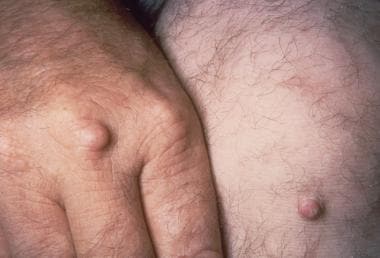 Tuberous xanthomas. Courtesy of Duke University Medical Center.
Significant increases of plant sterols (ie, phytosterols) are found in blood and various tissues. Arteries and xanthomas in patients with sitosterolemia contain increased amounts of these sterols, particularly sitosterol, stigmasterol, campesterol, and their 5-alpha derivatives.
Untreated, the condition causes a significant increase in morbidity and mortality. Coronary heart disease and its inherent health consequences are the primary causes of illness and premature death in untreated patients. With treatment, cholesterol levels can normalize, and xanthomas can completely regress.
A clue to sitosterolemia diagnosis in a patient with highly elevated plasma cholesterol level is parents with normal cholesterol levels.

Pathophysiology
The metabolic defect in the affected patient causes hyperabsorption of sitosterol from the GI tract, decreased hepatic secretion of sitosterol with subsequent decreased elimination, and altered cholesterol synthesis.
The defect associated with sitosterolemia manifests at 3 levels, culminating in greatly increased plasma sitosterol levels. Levels typically range from 10-65 mg/dL, with an average of 35 mg/dL. The reference range is 0.3-1 mg/dL but may increase to 9 mg/dL in infants fed commercial formulas high in vegetable oils. One report revealed extremely elevated plasma cholesterol in an affected breastfeeding infant. [5] Expanded total exchangeable pools of sitosterol (average 3500-6200 mg, with a reference range of 120-290 mg) also are evident.
Plant sterols are not synthesized endogenously in humans, including patients with sitosterolemia, but are derived entirely from the diet. Plant sterols are structurally similar to cholesterol except for substitutions at the C24 position on the sterol side-chain. Sitosterol has an added ethyl group.
Mammalian cells cannot use plant sterols. Plant sterols may normally be excluded because they are toxic in high doses. [6] Normally, plant sterols are poorly absorbed from the GI tract; fewer than 5% of plant sterols are absorbed compared with approximately 40% of cholesterol absorbed. The liver preferentially excretes plant sterols over cholesterol. Dietary sterols have recently been shown to passively enter intestinal cells, and, subsequently, the vast majority are pumped back into the gut lumen by ATP-binding cassette (ABC) transporter proteins.
Sitosterolemia has been shown to result from mutations in either of the genes for 2 proteins (ABCG5 or ABCG8). These ABC transporters preferentially pump plant sterols out of intestinal cells into the gut lumen and out of liver cells into the bile ducts, thereby decreasing sterol absorption. Consequently, the body absorbs only a small percentage of the plant sterols that reach the intestine. Absorbed sterols are packaged into chylomicrons for transport to the liver. In the liver, cholesterol and plant sterols may be transported to peripheral tissues by very low-density lipoprotein (VLDL) and low-density lipoprotein (LDL), converted to bile acids, or transported out of the liver into the bile for excretion.
In peripheral tissues, the ABC1 transporter (defective in Tangier disease) delivers cholesterol to high-density lipoprotein (HDL) for return to the liver. Phytosterols are metabolized in the liver into C21 bile acids via liver enzymes. Phytosterols have been shown to reduce serum and plasma total cholesterol and LDL levels in healthy individuals. [7] Little toxicity occurs, and no obvious adverse effects are associated with phytosterols when present in healthy individuals; however, in the disease state, toxicity is manifested by significant morbidity and increased risk for premature death. The pathophysiologic causes of coronary heart disease in sitosterolemia, especially concerning the effects of plant sterol and stanol intake, have been debated. [8]
Hyperabsorption
The intestinal pathway for cholesterol absorption is beginning to be elucidated. Mutations in the ABCG8 and ABCG5 genes were recently identified as the underlying cause of sitosterolemia. The active pumping back into the intestine of passively absorbed plant sterols is disrupted, and hepatic secretion of the resultant accumulation of these sterols is decreased. Animal studies have revealed that expression of G5 and G8 in either intestine or liver is sufficient to limit accumulation of plasma phytosterols in animal models of sitosterolemia, but expression in both tissues is required to maintain the very low levels observed in wild type animals. [9]
The ability of the liver to preferentially excrete plant sterols into the bile is apparently impaired. Although bile acid synthesis remains the same as in healthy people, the total excretion of sterols in the bile is reportedly less than 50% in subjects with sitosterolemia compared with control subjects. The mechanism for decreased hepatic secretion is unknown.
Reduced cholesterol synthesis
Sitosterolemia was originally thought to be associated with a single inherited defect in the hydroxymethylglutaryl-coenzyme A (HMG-CoA) reductase gene, but more recent studies suggest that inadequate cholesterol production in sitosterolemia is due to abnormal down-regulation of early, intermediate, and late enzymes in the cholesterol biosynthetic pathway.
Patients have markedly reduced whole-body cholesterol biosynthesis associated with suppressed hepatic, ileal, and mononuclear leukocyte HMG-CoA reductase, the rate-controlling enzyme in the cholesterol biosynthetic pathway.
Whether or not the down-regulation is due to accumulated sitosterol is still debatable, but most recent data indicate that secondary effects of unknown regulators other than sitosterol can lead to reduced HMG-CoA reductase activity in the disease. This is coupled with significantly increased LDL receptor expression.
The precise relationship between enhanced sterol absorption, hepatic sterol retention, and down-regulation of cholesterol biosynthesis underlying the disorder remains unknown; however, identification of these processes as characteristics of the disorder has led to viable treatment options.
Epidemiology
Frequency
International
Sitosterolemia is thought to be a very rare disorder. As of 2018, approximately 110 individuals with molecularly confirmed sitosterolemia had been reported worldwide. [10]
More than likely, sitosterolemia is significantly underdiagnosed. Many patients are probably misdiagnosed with hyperlipidemia; therefore, assay of plasma sterol levels, the definitive diagnostic test for sitosterolemia, is not performed. In one study, 220 hypercholesterolemic were tested for phytosterols. In this cohort, 3 patients with suspected sitosterolemia were identified, with 2 patients receiving molecular confirmation for a sitosterolemia diagnosis. [11] Individuals resistant to lipid lowering therapy should be considered for testing for sitosterolemia. [12] It appears that pathogenic variants in ABCG5/ABCG8 contribute substantially to both mimicking and exacerbating the FH phenotype. [13] Sequencing of ABCG5/ABCG8, the sitoesterolemia genes, in the workflow of an FH cascade screening program revealed a diagnosis of sitosterolemia in a substantial number of patients with high incidence of early atherosclerotic cardiovascular disease and hematologic abnormalities [14] .
Mortality/Morbidity
Little toxicity occurs, and no obvious adverse effects are associated with phytosterols in healthy individuals. However, when individuals have sitosterolemia, they have significant morbidity and increased risk for premature mortality. Coronary heart disease and its inherent health consequences are the primary causes of illness and premature death in patients with sitosterolemia.
Xanthomas occur most prominently in the extensor tendons of the hands and Achilles tendon. They can cause significant discomfort, interfere with mobility, and have cosmetic implications. One case of spinal cord compression secondary to multiple intradural extramedullary xanthomas has been reported.
Males with sitosterolemia have a high prevalence of accelerated atherosclerosis leading to coronary heart disease and subsequent premature death. The high content of plant sterols in the circulatory lipoproteins has been postulated to possibly promote their deposition in the arterial walls. Evidence of atherosclerosis often is present at diagnosis even in children. [15] Deaths have been reported in adolescent males as young as 13 years caused by coronary arthrosclerosis and secondary infarction. Angina pectoris has been reported in a 12-year-old girl.
Hematologic abnormalities including hemolysis (which can be episodic); platelet abnormalities, including thrombocytopenia, especially macrothrombocytopenia/giant platelets; stomatocytes; and pancytopenia [16, 17, 18] have been described. Ezetimibe ameliorates the effect on platelets. [19, 20] Erythrocytes have been shown to contain increased amounts of sitosterol, rendering the cell membrane more rigid and, therefore, more prone to lysis and rupture.
The clinical, biochemical, and molecular genetic features (mainly manifested by hematologic abnormalities) of a Chinese family with sitosterolemia were reported. [21] The main clinical features of these patients were hemolysis and macrothrombocytopenia. The authors suggested that blood cells could be a target for the toxic effect of plant sterols in blood. Another report of a case with macrothrombocytopenia, stomatocytic hemolysis, and splenomegaly without other obvious features of the condition was described. [22]
Arthralgias and arthritis can occur particularly in the knee and ankle joints.
Trace amounts of unsaturated plant sterols and cholesterol have been found in the brain tissue of people with sitosterolemia. The only identified neurologic complication to date is 1 reported case of paraplegia secondary to spinal cord compression by multiple intradural extramedullary xanthomas.
In patients with sitosterolemia, 5α-stanol accumulation may be associated with thyroid function. Ezetimibe reduces circulating 5α-stanol levels while increasing levels of FT3/FT4, implying increased conversion of T4 to T3, thus possibly improving thyroid hormone status. [23]
Abnormal liver function test results can be observed, and liver cirrhosis has been reported [24] at least once with successful treatment by liver transplant. [25] Heterozygotes likely are healthy, [26] although an elevated plasma plant sterol concentration of 3.07 mg/dL was found in one heterozygote. [27]
Race
As of 2018, approximately 110 individuals with molecularly confirmed sitosterolemia had been reported worldwide [10] ; therefore, very little information on racial or ethnic predilection is available, especially because bias of ascertainment is likely. No ethnic predilection is apparent in sitosterolemia, although the small number of patients diagnosed makes it premature to draw any conclusions.
Sitosterolemia has been described in Amish, Hutterite, Japanese, and Chinese patients, as well as in other patient population groups.
Sex
Sitosterolemia is an autosomal recessive genetic condition; therefore, no sex predilection is noted. Males may be more prone to the severe complications of sitosterolemia.
Age
The condition can manifest at any age. Xanthomas have been reported in patients as young as 18 months.
Prognosis
The prognosis for patients with sitosterolemia is unclear, given the extreme rarity of the disease. Early diagnosis and treatment correlate with a better outcome. Left untreated, sitosterolemia has significant morbidity and increased risk for early mortality. The availability of ezetimibe may dramatically improve the prognosis.
Patient Education
Dietary instruction by a licensed dietitian is helpful.
For excellent patient education resources, visit eMedicineHealth's Cholesterol Center. Also, see eMedicineHealth's patient education articles High Cholesterol, Cholesterol FAQs, and Atorvastatin (Lipitor).
-
Tuberous xanthomas. Courtesy of Duke University Medical Center.