Practice Essentials
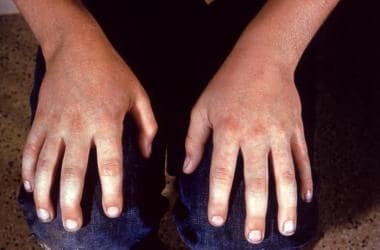
Parvovirus B19 (B19V) is a single-stranded DNA virus of the family Parvoviridae and genus Erythrovirus. Parvovirus B19 infects only humans. Approximately 60% of adults aged 30 years are immune to parvovirus B19, although few recall having had the infection. Symptoms include a low-grade fever, myalgias, arthralgias, headache, nausea, and rhinorrhea. As the symptoms disappear, children often develop a bright red rash on the cheeks (as if they had been slapped). The images below show examples of symptoms observed with parvovirus B19 infection.
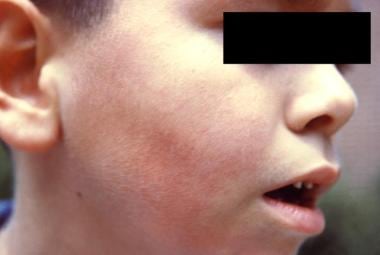 Note the right side of this boy's face displaying signs of erythema infectiosum, or fifth disease. Image courtesy of CDC.
The infection is contagious in children for a few days before symptoms begin and until the symptoms disappear. When the rash appears, the infection is no longer contagious. The presence of the parvovirus B19 rash is not a reason to keep children home from daycare or school.
If a pregnant person who is not immune to parvovirus B19 becomes infected, the probability of hydrops fetalis developing in the neonate is small (2-5%). Any pregnant person who is exposed to an individual in whom parvovirus B19 infection is suspected should immediately contact their obstetrician.
In healthy adults and children, parvovirus B19 is not a serious infection. Exceptions include patients with cancer who are receiving chemotherapy, as well as patients with HIV infection and/or acquired immunodeficiency syndrome (AIDS), organ transplants, and other immunodeficient states.

Background
Although parvoviruses commonly cause disease in animals, it was only in 1975 that the first human pathogen of this family was discovered by Cossart and colleagues while screening normal blood bank donors' sera for the hepatitis antigen (one of the donors' serum samples was coded B19). [1, 2]
The presence of immunoglobulin antibodies to this virus in the serum of half of the adult population was established by epidemiological surveys, suggesting acquisition of immunity during childhood. Evidence of recent infection (viral antigen, immunoglobulin M [IgM]-specific antibodies to the virus) was first found in the blood of Jamaican children living in London, England, all of whom presented with transient aplastic crisis (TAC) of sickle cell disease. [3]
Later, Serjeant et al confirmed the close association of parvovirus and aplastic crisis in a large retrospective study of sera from sickle cell disease patients with this complication. [4] Later, human parvovirus B19 was shown to be the etiologic agent of erythema infectiosum in hematologically normal persons. [5, 6] Erythema infectiosum was originally named fifth disease because it was the fifth of 6 classic exanthematous diseases of childhood to be described. Later, cases of nonimmune hydrops fetalis were reported when infection in a woman occurred during pregnancy [7] . Parvovirus B19 has also been associated with multiple other conditions. [8, 2, 5, 9, 10]
Pathophysiology
The incubation period from infection to initial, nonspecific symptoms ranges from 4-14 days; but cases have been reported as long as 21 days after exposure. The rash and joint symptoms usually occur 2-3 weeks after initial infection. Patients are most contagious in the few days preceding rash. Patients with aplastic anemia are considered contagious before the onset of symptoms and for at least 1 week. [5, 9, 8, 11]
Parvovirus B19 has a unique tropism for human erythroid progenitor cells. The virus requires the P blood antigen receptor (also known as globoside) to enter the cell. Rare individuals who lack the P antigen are immune to parvovirus B19 infection. Once inside the host cell, viral DNA enters the nucleus. The 3' end of the DNA strand folds back on itself, forming a hairpinlike bend that functions as a self-primer for viral DNA replication. The virus is cytotoxic to host cells. [2, 12] This, coupled with the tropism for rapidly dividing erythrocyte precursors (particularly pronormoblasts and normoblasts, wherein they replicate to high titers), leads to the suppression of erythrogenesis seen during infection. No reticulocytes (immature erythrocytes) are available to replace aging or damaged erythrocytes as they are cleared by the reticuloendothelial system. [5, 2]
Although decreases in hemoglobin levels of greater than 1 g/dL are rare in healthy children infected with parvovirus B19, decreases of 2-6 g/dL may be observed in patients with hemoglobinopathies or hemolytic anemias. Occasionally, the virus infects leukocytes (especially neutrophils). [13] Parvovirus B19 does not infect megakaryocytes; however, in vitro, parvovirus B19 proteins have a cytotoxic effect on megakaryocytes. Although B19V infection may manifest with pancytopenia, it is not believed to contribute significantly as an etiology of true aplastic anemia. [9, 11]
Fetal myocardial cells are known to express P antigen and may become infected with parvovirus B19. This may explain some of the direct myocardial effects seen in fetal infection. [2, 14]
Etiology
Classic fifth disease, aplastic crisis, and papular-purpuric "gloves-and-socks" syndrome (PPGSS) are caused almost exclusively by parvovirus B19. This virus, distributed worldwide, infects only humans. Transmission occurs via vertical transmission (birth), large droplet respiratory secretions, transfusion of blood products, and percutaneous exposure to blood. [9, 15]
Parvovirus B19 has been spread by blood products, such as intravenous immunoglobulin (IVIG), nonrecombinant clotting factors, platelets, and, to a lesser extent, packed RBCs. Because the virus lacks an outer lipid envelope and the genome is very stable, it is extremely resistant to heat, cold, and solvents. Since 2002, makers of plasma-derived products have screened for parvovirus B19. [2]
An investigation of parvovirus B19–seronegative recipients of blood components from donors who were positive for parvovirus B19 DNA using polymerase chain reaction (PCR) failed to demonstrate any evidence of transmission when the donors viral loads were below 106 IU/mL. [16] The authors concluded that screening of packed RBC (PRBC) transfusions may not be necessary.
Epidemiology
United States statistics
Parvovirus B19 infection is extremely common. Seropositivity rates are 5-10% among young children (aged 2-5 years), increasing to 50% by age 15 years and 60% by age 30 years. A small percentage of adults acquire infection every year, resulting in an incidence of approximately 90% in adults older than 60 years. [8, 6] The annual seroconversion rate among pregnant women without parvovirus B19 is 1.5%. [9]
Clinical cases of parvovirus B19 infection (erythema infectiosum) may be sporadic or may occur in outbreaks in the late winter through early spring. Attack rates during school outbreaks may be as high as 60%, [8] and secondary spread through nonimmune household contacts is common. A cyclic increase in the number of infections is also observed, peaking every 3-4 years. [8]
Infection can be an occupational hazard in child care workers, with a rate of 20% reported in some studies. [9] A meta-analysis found a parvovirus B19 seroprevalence of 70% among daycare workers. [17]
International statistics
Parvovirus B19 infection is common worldwide. The age distribution is similar to that observed in the United States. A small number of groups, living in remote geographical locations, have not been exposed to human parvovirus. [2]
Race-, sex-, and age-related demographics
No racial predilection is known.
In general, parvovirus B19 infection affects males and females in equal numbers. Adult females are more likely to develop postinfectious arthritis.
Parvovirus B19 infection is common in school-aged and younger children who attend daycare facilities. In general, children transmit the virus to parents and siblings. In young children, the antibody seroprevalence ranges from 5-10%. This increases to 50% in adolescents and approaches 90% in the elderly. [9, 2]
Prognosis
Most patients recover without sequelae.
Morbidity/mortality
Parvovirus B19 infection in otherwise healthy children and adults has an extremely low mortality rate. [5, 2, 11]
Morbidity is as follows:
-
Erythema infectiosum (fifth disease) is described in clinical manifestations below.
-
Polyarthropathy syndrome is mostly seen in adult women with acute infection. Patients develop acute symmetric arthritis affecting the small joints of the hands and feet, typically lasting for 1-3 weeks. In a small number, the arthritis may be prolonged, lasting for months. These symptoms can be confused with rheumatoid arthritis and further complicated by transient rheumatoid factor production during parvovirus B19 infection. [18] For this reason, parvovirus B19 infection should be considered in the differential diagnosis of newly diagnosed rheumatoid arthritis. Studies have not shown a causal link between parvovirus B19 infection and rheumatoid arthritis, and parvovirus B19 does not cause degenerative joint changes. [8]
-
In patients with hemoglobinopathies or hemolytic anemias, in whom the duration of erythrocyte survival is decreased, a decrease in the reticulocyte count to less than 1% (usually to 0%) may precipitate TAC. Such a crisis is characterized by profound anemia caused by a temporary halt in new erythrocyte production. [4] Abnormal erythrocytes, such as those associated with hemoglobinopathies, have a significantly shortened half-life because they are removed from circulation by the reticuloendothelial system. Any interruption in new erythrocyte production may trigger a crisis.
-
The bone marrow during TAC reveals an absence of erythroid precursors and the presence of striking giant pronormoblasts; rarely, necrosis may occur. [19] Parvovirus B19 is the only infectious cause of TAC known and has been shown to be the cause of aplastic crisis in over 80% of patients with sickle cell disease. [2, 8] .
-
Patients who are immunocompromised (eg, receiving chemotherapy or immunosuppressive drugs or have immune defects [congenital and acquired]) may develop chronic parvovirus B19 infection that results in chronic anemia. Pure red cell aplasia (PRAC) persists until the virus is cleared and should be distinguished from the transient anemia described above. [8, 5, 6, 10] Chronic parvovirus B19 infection in transplant recipients has been linked to anemia, other hematologic abnormalities, myocarditis, and pneumonitis. [20] Pediatric patients with hematologic malignancies and parvovirus B19 infection have suffered prolonged anemia that interferes with chemotherapy timing. [21]
-
Parvovirus B19 has been linked to other hematologic abnormalities. Thrombocytopenia, leukopenia, or both may be seen in acute infection, even in immunologically normal hosts. Cases of immune thrombocytopenic purpura, Henoch-Schönlein purpura, and the hemophagocytic syndrome have been attributed to parvovirus B19. However, transient erythroblastopenia of childhood and true aplastic anemia are not associated with infection. [8, 22, 11]
-
Hydrops fetalis, perhaps the most serious complication of parvovirus B19 infection, may occur when a nonimmune woman is infected, usually in the first 20 weeks of pregnancy. Note the following:
Parvovirus B19 infection is the most common cause of nonimmune hydrops fetalis and can result in fetal death in 2-6% of cases. [9, 23]
As many as 50% of women of childbearing age may not be immune to parvovirus B19 and are susceptible to infection. [5] The seroconversion rate in the same group is 1.5% per year. [9] The vertical infection rate is estimated at 25-50%. The rate of fetal loss is estimated to be 1.6-9%. [5, 24, 25, 26] Of fetuses infected in the first half of pregnancy, 85% develop hydrops develops within 10 weeks (mean 6-7 wk). In one case series, no fetus infected after 21 weeks' gestation developed severe anemia. [27]
The most critical gestational age appears to be 13-16 weeks' gestation, when the fetus has the highest rates of hepatic hematopoiesis.
Historically, hydrops had a 30% mortality rate; however, newer data demonstrate a resolution of 94% of cases within 6-12 weeks and a mortality rate of less than 10% if the fetus can be supported by transfusion. [28]
Investigators have also called attention to the occurrence of severe anemia in fetuses with hydrops and suggest this may complicate the transfusion procedure. [27]
Intrauterine growth retardation, myocarditis, and pleural and pericardial effusions may also occur; however, parvovirus B19 is not associated with a congenital malformation. [9, 8, 14, 25]
Infection in the pregnant patient is further covered below.
A guideline reviewed the evidence relating to the effects of parvovirus B19 on the pregnant woman and fetus, and also the management of women who are exposed to, who are at risk of developing, or who develop parvovirus B19 infection in pregnancy. Investigation for parvovirus B19 infection was recommended apart from the standard workup for fetal hydrops or intrauterine fetal death. [29, 30]
Complications
Complications include hydrops fetalis, chronic anemia, aplastic crisis, and death.
Immunocompetent individuals with a prolonged course of rash, fatigue, and arthralgias caused by persistent viremia have been reported. Symptoms in some of these patients respond to intravenous immunoglobulin (IVIG) therapy.
-
Note the right side of this boy's face displaying signs of erythema infectiosum, or fifth disease. Image courtesy of CDC.
-
Elementary school child with fifth disease. Image courtesy of CDC.