| AUTHOR INFORMATION
| Section 1 of 12  |
Authored by Beth A Pletcher, MD, Associate Professor, Co-Director of The Neurofibromatosis Center of New Jersey, Department of Pediatrics, University of Medicine and Dentistry of New Jersey
Beth A Pletcher, MD, is a member of the following medical societies:
American Academy of Pediatrics,
American College of Medical Genetics,
American Medical Association, and
American Society of Human Genetics
Edited by Elaine H Zackai, MD, Director of Clinical Genetics Center, Professor of Pediatrics, Department of Pediatrics, Division of Human Genetics and Molecular Biology, University of Pennsylvania, Children's Hospital of Philadelphia; Mary L Windle, PharmD, Adjunct Assistant Professor, University of Nebraska Medical Center College of Pharmacy, Pharmacy Editor, eMedicine.com, Inc;
Robert Anthony Saul, MD, Senior Clinical Geneticist, Greenwood Genetic Center; Clinical Professor, Department of Pediatrics, University of South Carolina;
Daniel Rauch, MD, FAAP, Director, Pediatric Hospitalist Program, Associate Professor, Department of Pediatrics, New York University School of Medicine;
and Bruce A Buehler, MD, Professor, Department of Pathology and Microbiology, Chairman, Department of Pediatrics, Director, Hattie B Munroe Center for Human Genetics, University of Nebraska Medical Center
eMedicine Journal, March 29 2006, VOLUME 7,
Number 3
 | INTRODUCTION
| Section 2 of 12  |
Background: Proteus syndrome is a rare condition that can be loosely categorized as a hamartomatous disorder. It is a complex disorder with multisystem involvement and great clinical variability. Once thought to have neurofibromatosis, Joseph Merrick (also known as "the elephant man") is now, in retrospect, thought by clinical experts to actually have had Proteus syndrome.
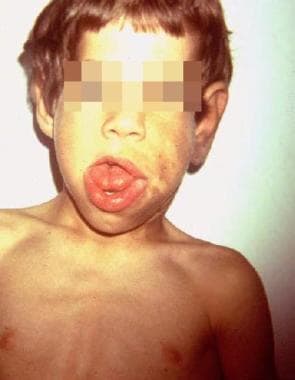
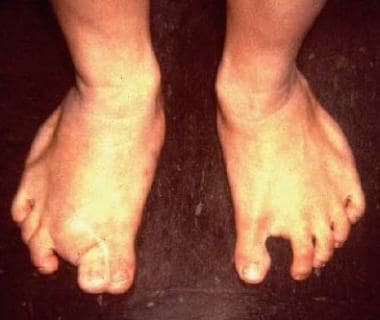
This condition is characterized by a variety of cutaneous and subcutaneous lesions including vascular malformations, lipomas, hyperpigmentation, and several types of nevi. Partial gigantism with limb or digital overgrowth is pathognomonic with an unusual body habitus and, often, cerebriform thickening of the soles of the feet. Because cutaneous lesions tend to appear over time, the diagnosis may be delayed until late infancy, childhood, or even adulthood. Orthopedic complications often pose the most challenging medical problems, although vascular complications also contribute to overall morbidity. Severe disfigurement and social stigmatization are additional challenges that must be addressed.
Pathophysiology: Manifestations probably result from somatic mosaicism for a dominant lethal gene, but the gene locus has yet to be identified. Reports of parents possibly transmitting mild cases to their children make this hypothesis questionable. Because hyperplasia and hypoplasia often occur together, another hypothesis suggests that the postzygotic event resulting in these clinical manifestations is embryonic somatic recombination leading to at least 3 subsets of cells. These subsets include normal, overgrowth (pleioproteus), and atrophy (elattoproteus) cells.
Frequency:
- Internationally: Proteus syndrome is believed to be exceedingly rare, with about 100-200 individuals affected worldwide. This suggests that prevalence is less than 1 per 1,000,000 live births.
Mortality/Morbidity:
- Hemihyperplasia (asymmetric overgrowth of the head, face, and digits) and soft tissue overgrowth represent some of the more significant medical complications.
- Facial involvement may be associated with not only asymmetric mandibular growth, maxillary growth, or both, but also premature dental eruption and idiopathic root resorption.
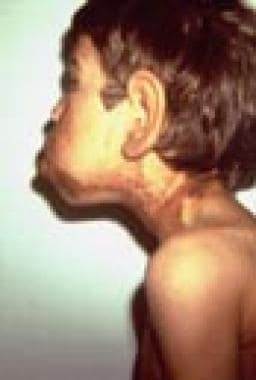
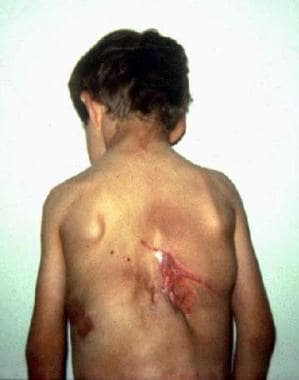
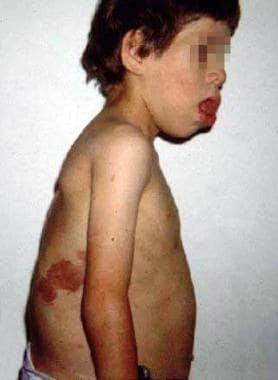
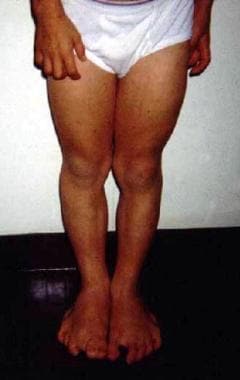
- Scoliosis or kyphoscoliosis may be severe and progressive, leading to respiratory compromise in some cases. Neck and trunk elongation with upper body wasting and leg muscle hypertrophy may contribute to overall abnormal body habitus and concomitant functional abnormalities.
- Cutaneous and subcutaneous lesions can create significant cosmetic and functional problems. Benign growths, such as lipomas, connective tissue nevi, epidermal nevi, and vascular malformations, may be locally invasive and contribute greatly to morbidity.
- Individuals with a larger number of skin manifestations are also more likely to have more severe involvement of other tissues.
- Cystic malformations of the lung and intrathoracic or intra-abdominal lipomas occur frequently.
- Increased risk for thrombotic events such as deep vein thrombosis (DVT) or pulmonary embolism (PE) contribute to the overall morbidity and mortality, even in young children.
- Learning disabilities or mental retardation occurs in a subset of patients. A particular facial phenotype often is associated with mental impairment with or without CNS malformations and seizures.
Race: No racial or ethnic differences in disease occurrence appear to exist.
Sex: Males and females are equally affected. However, males appear to be at greater risk for thrombosis than females.
Age: The genetic change or somatic event leading to this syndrome is likely to present shortly after conception and is propagated in one or more subsets of embryonic cells. Even so, the diagnosis may not be suspected in many individuals until later infancy or early childhood, depending on the degree of overgrowth or rate of cutaneous lesion appearance. A fetus was identified prenatally with ultrasound findings of a large right-sided mass and unusual hand configuration. In this case, however, the actual diagnosis was not made until postmortem examination.
History: The following are the 3 general criteria necessary for clinical diagnosis without regard to specific clinical features:
- Lesions follow a mosaic distribution or pattern.
- Problems follow a progressive course.
- The disorder appears to be sporadic (ie, not inherited).
Diagnostic confirmation also requires the presence of manifestations listed under the following categories:
- Category A (1 required) - Connective tissue nevus
- Category B (2 required)
- Epidermal nevus
- Disproportionate overgrowth of 1 or more of the following: limbs, digits, cranium, vertebrae, external auditory meatus, spleen, or thymus
- Bilateral ovarian cystadenomas or a parotid monomorphic adenoma in a patient younger than 20 years
- Category C (all 3 required)
- Lipomas or focal atrophy of adipose tissue
- Capillary, venous, or lymphatic malformation
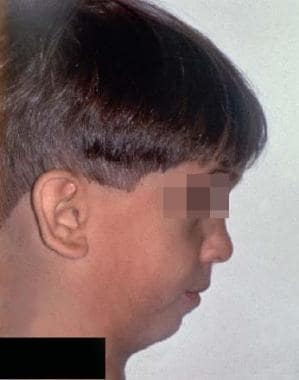
- Facial features including dolichocephaly, a long face, down-slanting palpebrae, ptosis, depressed nasal bridge, anteverted nares, and open mouth position while at rest
Physical:
- When present at birth, asymmetric limb, digital, or cranial overgrowth may be a major diagnostic finding.
- Digital, limb, or cranial overgrowth usually involves both soft tissue and bone.
- Cranial or external auditory canal hyperostosis may be seen.
- Scoliosis associated with disproportionate vertebral growth is common.
- The combination of disproportionate overgrowth and focal atrophy can lead to a unique habitus characterized by wasting of upper arm muscles, an elongated thorax, an extremely gracile neck, and muscular hypertrophy of the thighs.
- Cystic lung malformations leading to cystic pulmonary emphysema and restrictive lung disease secondary to severe scoliosis are relatively common. Recurrent pneumonias, shortness of breath, or reduced exercise tolerance may point to significant respiratory compromise.
- Organomegaly is less common but can also occur with splenomegaly or occasional thymus enlargement.
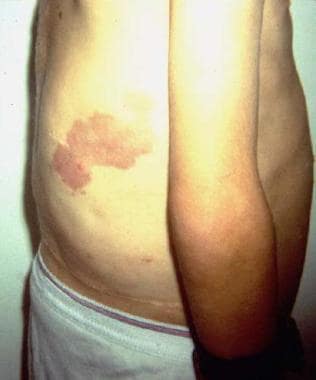
- The 6 most common skin findings include (from most to least frequent) lipomas, vascular malformations, connective tissue nevi, epidermal nevi, partial lipohypoplasia, and patchy dermal hypoplasia.
- Connective tissue nevi are virtually pathognomonic and typically have a cerebriform contour. They often occur on the soles of the feet but can also be found on other areas.
- Epidermal nevi tend to be the flat, soft variety.
- Lipomas may be well demarcated or locally invasive with large intra-abdominal or intrathoracic lesions presenting serious medical concerns.
- Vascular lesions may include capillaries, lymphatics, venules, or combinations of these. They tend to grow gradually over time and, unlike the more common capillary hemangiomas seen in the general population, rarely regress. Port wine stains or patchy hyperpigmentation also may be seen.
- Learning difficulties or mental retardation is seen in about 1 in 5 individuals with Proteus syndrome.
- Facial features that often coincide with poor mental development include a prominent occiput, ptosis with or without down-slanting palpebrae, upturned nose, and a long, narrow face.
- Seizures are reported in more than 10% of affected individuals.
 | DIFFERENTIALS
| Section 4 of 12  |
Klippel-Trenaunay-Weber Syndrome
Neurofibromatosis
Other Problems to be Considered:
Encephalocraniocutaneous lipomatosis
Hemihyperplasia lipomatosis syndrome
Lab Studies:
- No molecular test is currently available.
- Platelet estimates may be indicated for patients with a number of vascular malformations or splenomegaly, especially if there is a history of easy bruising or petechiae.
- A coagulation workup may be indicated preoperatively for patients with Proteus syndrome in light of the apparent increased risks for thrombotic events such as DVT or PE.
Imaging Studies:
- Radiographs
- A baseline skeletal survey is recommended for all individuals at the time of diagnosis with follow-up radiographs as necessary.
- Consider anteroposterior (AP) and lateral spine radiographs for an affected child with clinical evidence of scoliosis or kyphosis.
- Radiographs of enlarged digits or limbs may be necessary if orthopedic intervention is considered.
- Magnetic resonance imaging or computed tomography
- Either may help evaluate intracranial anatomy, especially cranial asymmetry that might be associated with cerebral cortex overgrowth. Magnetic resonance imaging (MRI) of the head is also an important screening tool for intracranial malformations in children with seizures or developmental delay.
- A 3-dimensional computed tomography (CT) scan may be very useful in evaluating bony overgrowth of the cranium or facial structures; however, both soft tissue and bony involvement are typical for a related hemihyperplasia.
- MRI of the thorax, abdomen, or extremities may be necessary to define the boundaries of a subcutaneous lesion such as a vascular malformation or lipoma that extends deep into soft tissues. Abdominal and thoracic MRIs are vital screening tools even when clinical symptoms are absent since undiagnosed internal lipomas can cause future problems.
- High-resolution chest CT scan may especially help identify pulmonary cystic malformations in patients with recurrent pneumonias, atelectasis, or respiratory compromise.
Other Tests:
- An electroencephalogram is indicated for any patient with a history or symptoms suggesting seizures.
- Pulmonary function tests may help evaluate patients with respiratory symptoms.
- Venograms, Doppler studies, or ventilation/perfusion (V/Q) studies may be helpful diagnostic tools in patients with symptoms suggestive of DVT or PE.
Histologic Findings: Connective tissue nevi resemble tightly compacted, collagen-rich connective tissue. Epidermal nevi generally exhibit a combination of hyperkeratosis, parakeratosis, acanthosis, and papillomatosis. Lipomas, whether invasive or well circumscribed, are made up of benign-appearing, mature adipocytes. Vascular malformations are of the single-channel type with capillaries, venules, lymphatics, or combinations of these noted within the lesions.
 | TREATMENT
| Section 6 of 12  |
Medical Care:
- The mainstays of treatment are the following:
- Identify serious medical problems early.
- Employ prophylactic and symptomatic treatment.
- Hemihyperplasia
- Medical approaches are limited and should be considered in the context of functional improvement.
- Leg length discrepancy can create a host of secondary morbidities and needs to be addressed by an experienced orthopedist.
- Macrodactyly can make it difficult for the patient to write, hold objects, dress, eat, or find comfortable footwear.
- Hemifacial macrosomia or macroglossia
- These present cosmetic concerns and may affect dental occlusion and mastication.
- Augment routine dental and orthodontic care with a maxillofacial surgeon or craniofacial team consultation as indicated.
- Scoliosis: Early recognition may permit nonsurgical attempts to halt progression.
- Cutaneous and subcutaneous lesions: Periodic evaluation is essential since lipomas and vascular malformations may have local or even systemic effects.
- Cutaneous vascular markings and malformations: Laser treatment is useful for removing cutaneous vascular markings and malformations such as port wine stains and capillary hemangiomas. It is not yet effective for permanently removing café au lait spots or melanin-related hyperpigmentation.
- Secondary thrombocytopenia: This may be indicated by a history of easy bruising or presence of petechiae.
- Thrombosis: Aggressive management of thrombosis may be lifesaving in patients who present with calf or leg pain, a palpable cord, and shortness of breath or respiratory distress.
- Internal lesions: Screening MRIs of the chest and abdomen can identify internal lesions such as lipomas or pulmonary cysts. Undetected, these can cause very serious problems before becoming symptomatic.
Surgical Care:
- Preoperative coagulation studies may provide guidance for perioperative and postoperative management of patients with Proteus syndrome.
- Progressive scoliosis may require orthopedic intervention.
- Exceptionally large digits may require surgical reduction in extreme circumstances so that the patient can wear shoes or use a hand.
- Hemifacial macrosomia or macroglossia may require surgical intervention if airway obstruction, feeding difficulties, or severe malocclusion is present. These complex situations often require a coordinated, multidisciplinary team approach with input from a craniofacial surgeon, orthodontist, and dentist.
- Although any competent surgeon can resect large or invasive cutaneous or subcutaneous lesions, plastic surgical consultation is advisable for cosmetically important areas such as the face. Subcutaneous lesions impinging on vital structures, obstructing vision, or growing rapidly deserve immediate attention.
- Internal lipomas or cystic lung malformations also may require surgical resection.
Consultations:
- An orthopedist is a vital team member who will need to address the functional significance of both hemihyperplasia and scoliosis.
- A craniofacial surgeon or surgical team can address cranial asymmetry or hemifacial macrosomia.
- A general or plastic surgeon can address resection of cutaneous or subcutaneous lesions when necessary.
- A neurosurgeon can address CNS lesions such as cortical overgrowth, with or without hydrocephalus. Patients undergoing complex craniofacial procedures also can benefit from a neurosurgeon’s operative expertise.
- A dermatologist can evaluate and monitor subcutaneous and cutaneous lesions and can perform biopsies when necessary.
- An ophthalmologist can closely monitor strabismus or orbital asymmetry in a patient with ocular involvement.
- A dentist can address dental anomalies and an orthodontist can treat malocclusion.
- A geneticist and genetic counselor can provide the patient and family with additional information about the diagnosis, diagnostic testing, proposed genetic mechanisms, and recurrence risks. Family planning options and prenatal diagnosis are also addressed in this clinical setting.
- A developmental pediatrician can evaluate a child with learning disabilities or developmental delays. This specialist makes recommendations for ongoing therapy and school interventions.
- A psychologist or trained mental health professional can assist a child or adolescent with significant disfigurement, if adjustment problems arise. Social stigmatization is a major obstacle for many children and adults. Both patients and family members may benefit from ongoing psychotherapy.
Activity:
- In the absence of surgery, encourage patients to participate in all activities as fully as possible. Patients who undergo spinal fusion or other major surgical procedures need to confer with their surgeons about acceptable activities.
 | MEDICATION
| Section 7 of 12  |
Drug therapy currently is not a component of the standard of care for this syndrome (see Treatment).
 | FOLLOW-UP
| Section 8 of 12  |
Further Inpatient Care:
- Hospitalization may be necessary for major surgical procedures.
Further Outpatient Care:
- Although patients need comprehensive primary care, the condition is so rare and complex that it is advisable to have an experienced subspecialist, such as a geneticist, serve as medical coordinator. Annual examinations focusing on common complications and disease progression with appropriate subspecialty referrals are in order.
Complications:
- Hemihyperplasia, asymmetric overgrowth of limbs or digits, and megalospondylodysplasia
- Scoliosis with or without unusual habitus
- Macrocephaly, macroglossia, and cranial or auditory canal hyperostosis
- Connective tissue nevi, epidermal nevi, lipomas, or vascular malformations
- Clinically silent but locally invasive internal lipomas or vascular malformations
- Pulmonary cystic malformations
- DVTs, PEs, or both
- Splenomegaly or thymic enlargement
- Ovarian cystadenomas or parotid adenoma
- Strabismus
- Dental anomalies
- Learning disabilities or mental retardation
Prognosis:
- Although data on long-term survival are not currently available, complications, such as central nervous system malformations, severe and progressive scoliosis, thrombotic events, and invasive internal lesions, are likely to contribute to premature death in a subset of affected individuals.
- Prompt attention to complications and early detection of potential problems may significantly reduce overall morbidity and mortality.
Patient Education:
 | MISCELLANEOUS
| Section 9 of 12  |
Medical/Legal Pitfalls:
- Failure to identify early scoliosis so that nonsurgical approaches can be instituted
- Failure to identify potentially invasive or progressive intrathoracic or intra-abdominal lesions
 | TEST QUESTIONS
| Section 10 of 12  |
CME Question 1: Which of the following is not a clinical criterion used to confirm the diagnosis of Proteus syndrome?
A: Connective tissue nevus
B: Mosaic distribution of lesions
C: Asymmetric overgrowth of digits
D: Pulmonary cystic malformation
E: Vascular malformation
The correct answer is D: Although pulmonary cystic malformations are seen in about 12-13% of affected individuals, they are not used for diagnostic confirmation.
CME Question 2: Which cutaneous or subcutaneous lesion is not typically a part of the Proteus syndrome spectrum?
A: Lipoma
B: Neurofibroma
C: Connective tissue nevus
D: Single-channel vascular malformation
E: Epidermal nevus
The correct answer is B: All of these lesions are commonly seen in Proteus syndrome except for a neurofibroma, which is more likely to indicate neurofibromatosis. Connective tissue nevi with a gyriform contour are often seen on the soles of the feet and may be very helpful diagnostically when present.
Pearl Question 1 (T/F): Joseph Merrick, the so-called "elephant man" of movie fame, probably had Proteus syndrome rather than neurofibromatosis, as was originally claimed.
The correct answer is True: This famous patient of Sir Frederick Treves had many of the unique features of Proteus syndrome, including the cerebriform pattern of thickening of the soles of his feet; however, it is easy to see how the clinical overlap between these 2 conditions created confusion about the diagnosis.
Pearl Question 2 (T/F): Proteus syndrome probably results from a new dominant mutation in a subset of cells (mosaicism) that might be lethal in a nonmosaic form.
The correct answer is True: Research suggests that this may be the case, and this theory is supported by the unusual patchy or mosaic distribution of lesions found in this condition.
Pearl Question 3 (T/F): Bone marrow failure is a probable cause of thrombocytopenia in Proteus syndrome.
The correct answer is False: The 2 most common causes of thrombocytopenia in Proteus syndrome are (1) vascular malformations leading to excessive platelet destruction or (2) splenomegaly resulting in platelet pooling or consumption.
Pearl Question 4 (T/F): Laser therapy is a valuable tool for treating cutaneous vascular malformations such as port wine stains.
The correct answer is True: In recent years, dermatologists and cosmetic surgeons use laser treatment for deeply pigmented lesions with variable but clear-cut success.
 | PICTURES
| Section 11 of 12  |
 | BIBLIOGRAPHY
| Section 12 of 12 |
-
Becktor KB, Becktor JP, Karnes PS, Keller EE: Craniofacial and dental manifestations of Proteus syndrome: a case report. Cleft Palate Craniofac J 2002 Mar; 39(2): 233-45[Medline].
-
Biesecker LG, Peters KF, Darling TN, et al: Clinical differentiation between Proteus syndrome and hemihyperplasia: description of a distinct form of hemihyperplasia. Am J Med Genet 1998 Oct 2; 79(4): 311-8[Medline].
-
Biesecker LG, Happle R, Mulliken JB, et al: Proteus syndrome: diagnostic criteria, differential diagnosis, and patient evaluation. Am J Med Genet 1999 Jun 11; 84(5): 389-95[Medline].
-
Cohen MM: Further diagnostic thoughts about the Elephant Man. Am J Med Genet 1988 Apr; 29(4): 777-82[Medline].
-
Cohen MM: Mental deficiency, alterations in performance, and CNS abnormalities in overgrowth syndromes. Am J Med Genet C Semin Med Genet 2003 Feb 15; 117(1): 49-56[Medline].
-
Franc-Guimond J, Houle AM, Barrieras D: The proteus syndrome associated with life threatening hematuria. J Urol 2003 Dec; 170(6 Pt 1): 2418-9[Medline].
-
Goodship J, Redfearn A, Milligan D, et al: Transmission of Proteus syndrome from father to son? J Med Genet 1991 Nov; 28(11): 781-5[Medline].
-
Hamm H: Cutaneous mosaicism of lethal mutations. Am J Med Genet 1999 Aug 6; 85(4): 342-5[Medline].
-
Happle R: Lethal genes surviving by mosaicism: a possible explanation for sporadic birth defects involving the skin. J Am Acad Dermatol 1987 Apr; 16(4): 899-906[Medline].
-
Happle R: Elattoproteus syndrome: delineation of an inverse form of Proteus syndrome. Am J Med Genet 1999 May 7; 84(1): 25-8[Medline].
-
Hoeger PH, Martinez A, Maerker J, Harper JI: Vascular anomalies in Proteus syndrome. Clin Exp Dermatol 2004 May; 29(3): 222-30[Medline].
-
Kruger G, Pelz L, Wiedemann HR: Transmission of Proteus syndrome from mother to son? [letter]. Am J Med Genet 1993 Jan 1; 45(1): 117-8[Medline].
-
Nazzaro V, Cambiaghi S, Montagnani A, et al: Proteus syndrome. Ultrastructural study of linear verrucous and depigmented nevi. J Am Acad Dermatol 1991 Aug; 25(2 Pt 2): 377-83[Medline].
-
Nguyen D, Turner JT, Olsen C, et al: Cutaneous manifestations of proteus syndrome: correlations with general clinical severity. Arch Dermatol 2004 Aug; 140(8): 947-53[Medline].
-
Plotz SG, Abeck D, Plotz W, Ring J: Proteus syndrome with widespread portwine stain naevus. Br J Dermatol 1998 Dec; 139(6): 1060-3[Medline].
-
Sigaudy S, Fredouille C, Gambarelli D, et al: Prenatal ultrasonographic findings in Proteus syndrome. Prenat Diagn 1998 Oct; 18(10): 1091-4[Medline].
-
Turner JT, Cohen MM, Biesecker LG: Reassessment of the Proteus syndrome literature: application of diagnostic criteria to published cases. Am J Med Genet A 2004 Oct 1; 130(2): 111-22[Medline].
-
Twede JV, Turner JT, Biesecker LG, Darling TN: Evolution of skin lesions in Proteus syndrome. J Am Acad Dermatol 2005 May; 52(5): 834-8[Medline].
-
Wiedemann HR, Burgio GR, Aldenhoff P, et al: The proteus syndrome. Partial gigantism of the hands and/or feet, nevi, hemihypertrophy, subcutaneous tumors, macrocephaly or other skull anomalies and possible accelerated growth and visceral affections. Eur J Pediatr 1983 Mar; 140(1): 5-12[Medline].
| NOTE: |
| Medicine is a constantly changing science and not all therapies are clearly established. New research changes drug and treatment therapies daily. The authors, editors, and publisher of this journal have used their best efforts to provide information that is up-to-date and accurate and is generally accepted within medical standards at the time of publication. However, as medical science is constantly changing and human error is always possible, the authors, editors, and publisher or any other party involved with the publication of this article do not warrant the information in this article is accurate or complete, nor are they responsible for omissions or errors in the article or for the results of using this information. The reader should confirm the information in this article from other sources prior to use. In particular, all drug doses, indications, and contraindications should be confirmed in the package insert. FULL DISCLAIMER |
eMedicine Journal, March 29 2006, VOLUME 7,
Number 3
© Copyright 2001, eMedicine.com, Inc.
|
Please email us with any comments you have on our new chapter format.
|