Practice Essentials
Medullary sponge kidney (MSK) is likely the result of an abnormality in renal development, as evidenced by the occasional presence of embryonal tissue in the affected papillae. Findings suggest that medullary sponge kidney may result from disruption of the ureteric bud/metanephric-blastema interface that is critical in normal kidney development. [1]
Medullary sponge kidney is characterized by ectasia and cystic formation in the medullary collecting duct. This characterization contrasts with autosomal recessive polycystic kidney disease and with autosomal dominant polycystic kidney disease, in which cysts predominantly develop along the cortical collecting tubule or the entire nephron, respectively. Medullary cysts give the kidney the gross anatomic appearance of a sponge. In the absence of hematuria, renal calculi, or infection, the disease is an asymptomatic nonprogressive condition. See the images below.
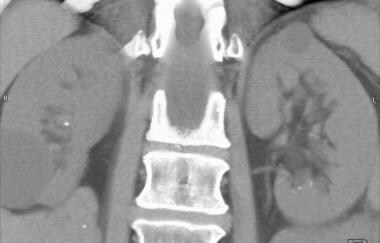 Unenhanced coronal volume-rendered (VR) CT image of the kidneys demonstrates 2 small calculi in the mid portion of the right kidney and 2 small calculi in the lower pole of the left kidney (arrowheads). A large low-density lesion in the lower pole of the right kidney and a small low-density lesion in the upper pole of the left kidney (short arrows) were shown to represent benign simple renal cysts on the contrast enhanced CT images. Image courtesy of Dr. Terri J. Vrtiska, Consultant, Department of Radiology, Mayo Clinic College of Medicine, Rochester, Minnesota, USA.
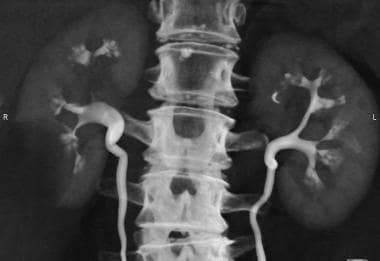 CT image of both kidneys demonstrates brushlike densities throughout multiple papillae of both kidneys consistent with renal tubular ectasia. Correlation of the stone disease with the ectatic tubules is diagnostic of medullary sponge kidney. Image courtesy of Dr. Terri J. Vrtiska, Consultant, Department of Radiology, Mayo Clinic College of Medicine, Rochester, Minnesota, USA.
Signs and symptoms
Patients with medullary sponge kidney are usually asymptomatic. They may develop microhematuria or gross hematuria, renal stones, or urinary tract infections.
Although physical examination findings are typically normal, as many as 25% of patients have hemihypertrophy, and 10% of patients with hemihypertrophy may have medullary sponge kidney.
See Presentation for more detail.
Diagnosis
Laboratory studies
In patients with medullary sponge kidney and hemihypertrophy, serial screening should be performed to exclude malignancies. The following studies are also indicated:
-
Urinalysis
-
A 24-hour urine collection for calcium, magnesium, and citrate
Imaging studies
Intravenous pyelography reveals radial, linear striations in the papillae or cystic collections of contrast material in ectatic collecting ducts.
See Workup for more detail.
Management
No specific treatment for medullary sponge kidney is warranted.
See Treatment and Medication for more detail.

Pathophysiology
The kidney is the primary organ affected. Ectasia and cystic malformation are present along the intrapyramidal or intrapapillary portion of the medullary collecting duct. Cysts may be heterogeneous in size within one kidney and between the 2 kidneys, ranging in size from 1-3 mm. Cysts may communicate and often contain spherical concretions composed of apatite.
The association of medullary sponge kidney with different malformation conditions suggests that it belongs to the developmental disorders that result from disruption of the ureteric bud-metanephric blastema interface. This is based on the occasional presence of remnant embryonal tissue in the affected papillae. Pathological studies suggest that medullary sponge kidney is due to an obstruction of the fetal-collecting duct or to a structural defect caused by hypercalciuria. Although the cause of medullary sponge kidney is unknown, family occurrence suggests a genetic component.
Medullary sponge kidney has been linked to defects in tubular function, including acidification and concentration. Two patients with medullary sponge kidney in association with distal renal tubular acidosis, late sensorineural hearing loss, and a mutation in the proton pump genes ATP6V1B1 and ATP6V0A4 were described. [2] [3]
In one study, 55 patients with medullary sponge kidney were evaluated for sequence variations in the glial cell-derived neurotrophic factor (GDNF) gene. [4] Two novel variations were found in the heterozygous state in 8 patients. A case-control study confirmed that these 2 alleles were associated with medullary sponge kidney. Interestingly, 5 of the 8 cases were found to be familial in a seemingly dominant pattern of inheritance. This report is interesting because GDNF and its receptor, RET, are involved in renal development. Thus, mutations in GDNF may lead to abnormal kidney morphogenesis that can manifest as medullary sponge kidney.
Medullary sponge kidney may be part of other syndromes and conditions such as Beckwith-Wiedemann syndrome (BWS), hemihypertrophy, Caroli disease, Ehlers-Danlos syndrome, Marfan syndrome, and pyloric stenosis. Medullary sponge kidney may occur in as many as 12.5% of cases of BWS, if congenital hemihypertrophy is part of the clinical picture. Finally, medullary sponge kidney was recently described in a 10-year-old boy with Rabson-Mendenhall syndrome (ie, severe insulin resistance, hyperinsulinemia, postprandial hyperglycemia, growth retardation, and dysmorphic features). [5]
Etiology
The cause of medullary sponge kidney is unknown. No cases link medullary sponge kidney to a drug or environmental exposure.
Cases occasionally occur in a familial pattern consistent with autosomal dominant transmission. In these circumstances, medullary sponge kidney may be associated with unilateral renal agenesis or other renal or genitourinary tract abnormalities.
Epidemiology
United States statistics
The prevalence rate is 1 case per 5,000-20,000 population. Medullary sponge kidney may be detected in 0.5-1% of asymptomatic individuals who undergo renal imaging studies for assorted clinical indications. In a 2013 study of 50 patients with medullary sponge kidney, based on careful interviews, renal imaging, and biochemical studies, 27 probands with medullary sponge kidney had 59 first- and second-degree relatives of both sexes with medullary sponge kidney in all generations. This is the strongest evidence of familial clustering of the disease with an autosomal dominant pattern of inheritance. [6]
International statistics
Evidence indicates that worldwide incidence of medullary sponge kidney is similar to that found in the United States.
Race-, sex-, and age-related demographics
No epidemiologic data indicate that incidence varies among racial or ethnic subgroups.
No evidence indicates that the frequency differs between the sexes. Fewer than 5% of cases are familial, and a clear genetic basis for medullary sponge kidney has not been established. The only genetic pattern observed in select pedigrees is an autosomal dominant type of transmission. Medullary sponge kidney appears to be somewhat more severe in women; the incidence of renal calculi and UTIs in women is higher than in men.
Symptoms occur primarily in adults aged 20-50 years; however, infants as young as 2 years and adolescents have shown clinical symptoms.
Prognosis
Medullary sponge kidney is a nonprogressive disease and has no adverse impact on renal or patient survival.
Morbidity/mortality
Morbidity or mortality is not directly related to medullary sponge kidney. In the absence of hematuria, urinary tract infection (UTI), or renal calculi, medullary sponge kidney is usually a nonprogressive asymptomatic condition. Under normal conditions, patients may have a mild urinary-concentrating defect or low-grade proteinuria.
Patients have a higher risk for developing calcium oxalate/apatite or struvite renal calculi. [7] Factors that may contribute to the susceptibility to recurrent calcium urolithiasis include: (1) urine stasis, (2) incomplete renal tubular acidosis (RTA) with a mild defect in urinary acidification and increased urine pH levels, (3) hypocitric aciduria, and (4) hypercalciuria. Patients are usually aged 20-50 years at presentation, although the condition may occur in children younger than 5 years. As many as 20% of adults with kidney stones may have medullary sponge kidney. The lifetime risk of renal stones may be as high as 60% in adults with medullary sponge kidney.
In a review of 56 patients with a radiographic diagnosis of medullary sponge kidney, 39 (70%) had nephrolithiasis confirmed by x-ray studies, and, of these, 13 had recurrent episodes. [8] The prevalence of medullary sponge kidney is higher (8.5%) in adults with renal stones compared with the control population (1.5%). Medullary sponge disease is often the cause of asymptomatic stones that are detected during the evaluation of potential kidney donors. [9] The corresponding figure in children is unknown. Among patients with kidney stones, hypercalciuria may occur in 40-50% and recurrent gross hematuria may occur in 10-20%.
Hyperparathyroidism is frequently associated with medullary sponge kidney and was thought to cause the disease and trigger stone formation. However, the urinary findings and clinical features of medullary sponge kidney usually precede the detection of hyperparathyroidism.
Although no evidence indicates that risk of UTIs is higher in patients with medullary sponge kidney, as many as 5% of males and 35% of females have a UTI. These patients do not have an increased frequency of concomitant structural anomalies (eg, vesicoureteral reflux) to account for the occurrence of UTI.
Because patients with medullary sponge have hypercalciuria and incomplete distal RTA, they may be at risk for developing bone disease. In fact, a study of 75 patients with medullary sponge kidney demonstrated that most had either osteopenia or osteoporosis based on bone densitometry T scores between -1.0 and -2.5 (approximately 60%) or < -2.5 (approximately 10%), respectively. The administration of oral potassium citrate supplements led to an increase in urinary pH, reduction in hypercalciuria, and improvement in bone density. [10]
Complications
Complications include the following:
-
Gross hematuria
-
Renal stones
-
UTIs
Patient Education
Inform the patient of possible complications.
For patient education resources, see the Kidneys and Urinary System Center, as well as Blood in the Urine.
-
Unenhanced coronal volume-rendered (VR) CT image of the kidneys demonstrates 2 small calculi in the mid portion of the right kidney and 2 small calculi in the lower pole of the left kidney (arrowheads). A large low-density lesion in the lower pole of the right kidney and a small low-density lesion in the upper pole of the left kidney (short arrows) were shown to represent benign simple renal cysts on the contrast enhanced CT images. Image courtesy of Dr. Terri J. Vrtiska, Consultant, Department of Radiology, Mayo Clinic College of Medicine, Rochester, Minnesota, USA.
-
CT image of both kidneys demonstrates brushlike densities throughout multiple papillae of both kidneys consistent with renal tubular ectasia. Correlation of the stone disease with the ectatic tubules is diagnostic of medullary sponge kidney. Image courtesy of Dr. Terri J. Vrtiska, Consultant, Department of Radiology, Mayo Clinic College of Medicine, Rochester, Minnesota, USA.