eMedicine Journal
>
Pediatrics
>
Neonatology
Kernicterus
Synonyms, Key Words, and Related Terms: kernicterus, acute bilirubin encephalopathy, chronic postkernicteric bilirubin encephalopathy, chronic bilirubin encephalopathy, profound pathologic hyperbilirubinemia
|
|
|
 | AUTHOR INFORMATION
| Section 1 of 12  |
Authored by Shelley C Springer, MD, MBA, MSc, Neonatologist, Assistant Professor of Pediatrics, Department of Pediatrics, University of Vermont, Burlington
Coauthored by David J Annibale, MD, Director of Fellowship Training Program in Neonatal-Perinatal Medicine, Associate Professor, Department of Pediatrics, Medical University of South Carolina
Shelley C Springer, MD, MBA, MSc, is a member of the following medical societies:
American Academy of Pediatrics,
American Medical Association,
Minnesota Medical Association,
National Perinatal Association, and
South Carolina Medical Association
Edited by Oussama Itani, MD, FAAP, FACN, Clinical Associate Professor of Pediatrics and Human Development, Michigan State University; Medical Director, Department of Neonatology, Borgess Medical Center; Mary L Windle, PharmD, Adjunct Assistant Professor, University of Nebraska Medical Center College of Pharmacy, Pharmacy Editor, eMedicine.com, Inc;
David A Clark, MD, Chairman, Professor, Department of Pediatrics, Albany Medical College;
Carol L Wagner, MD, Professor of Pediatrics, Medical University of South Carolina;
and Ted Rosenkrantz, MD, Head, Division of Neonatal-Perinatal Medicine, Professor, Departments of Pediatrics and Obstetrics/Gynecology, University of Connecticut School of Medicine
eMedicine Journal, July 31 2006, VOLUME 7,
Number 7
 | INTRODUCTION
| Section 2 of 12  |
Background: Traditionally, the term kernicterus (literally yellow kern, with kern indicating the most commonly afflicted region of the brain, ie, the nuclear region) refers to an anatomic diagnosis made at autopsy based on a characteristic pattern of staining found in babies who had marked hyperbilirubinemia before they died.
Hervieux first described the condition in 1847, and Schmorl first used the term kernicterus as early as 1903. Regions most commonly affected include the basal ganglia; hippocampus; geniculate bodies; and cranial nerve nuclei, such as the oculomotor, vestibular, and cochlear. The cerebellum can also be affected. Bilirubin-induced neurologic dysfunction (BIND) refers to the clinical signs associated with bilirubin toxicity (ie, hypotonia followed by hypertonia, opisthotonus or retrocollis, or both) and is typically divided into acute versus chronic phases. The 2 terms are commonly used interchangeably, but this use is not technically accurate because one refers to clinical manifestations and the other to an anatomic diagnosis.
Prevalent in the 1950s and 1960s, kernicterus had virtually disappeared from the clinical scene, only to reappear during the 1990s. Early discharge of term infants (before their bilirubin peaks) may be a factor in the reemergence of this devastating neurologic affliction.
Much of the traditional teaching regarding hyperbilirubinemia is now being questioned as more is learned about bilirubin metabolism and neurologic injury. Kernicterus is now recognized to occur in the premature infant and very rarely in the term infant in the absence of profound hyperbilirubinemia. Conversely, physiologic jaundice (sometimes to levels previously thought to be universally dangerous) has been recognized to be within the reference range in the first week of life in healthy term babies, particularly those who are breastfed. Jaundice of this type resolves spontaneously, without sequelae.
Despite the lack of a clear-cut cause-and-effect relationship between kernicterus and hyperbilirubinemia, laboratory investigations have demonstrated that bilirubin is neurotoxic at a cellular level. Other in vitro studies have shown bilirubin to have more antioxidant capability than vitamin E, which is commonly assumed to be the most potent antioxidant in the human system. This possible role of bilirubin in early protection against oxidative injury, coupled with identification of multiple neonatal mechanisms to preserve and potentiate bilirubin production, has led to speculation about an as-yet-unrecognized beneficial role for bilirubin in the human neonate.
Pathophysiology: Bilirubin staining can be noted on autopsy of fresh specimens in the regions of the basal ganglia, hippocampus, substantia nigra, and brainstem nuclei. Such staining can occur in the absence of severe hyperbilirubinemia; in this situation, factors influencing permeability of the blood-brain barrier (eg, acidosis, infection) and the amount of unbound (versus albumin-bound) bilirubin may play a role.
Characteristic patterns of neuronal necrosis leading to the clinical findings consistent with chronic bilirubin encephalopathy are also essential in the pathophysiology of this entity. Bilirubin staining of the brain without accompanying neuronal necrosis can be observed in babies who did not demonstrate clinical signs of bilirubin encephalopathy but who succumbed from other causes. This staining is thought to be a secondary phenomenon, dissimilar from the staining associated with kernicterus.
MRI may be emerging as an instrumental tool to help clarify the complex picture of kernicterus in contrast with asymptomatic bilirubin staining of brain tissues. Bilirubin staining has been suggested to be visualized on MRI as an increased signal in the posteromedial aspect of the globus pallidus.
Frequency:
- In the US: The exact incidence of kernicterus is unknown. A pilot kernicterus registry monitoring the cases of babies with kernicterus in the United States who have been voluntarily reported shows 125 babies with chronic kernicterus enrolled in the registry from 1984-2002. All but 4 babies reported in the registry had been discharged from the hospital fewer than 72 hours after birth (97%). Five babies were born at home (4%). No sequelae were identified in 9 of 115 infants, and 1 was lost to follow-up.
- Internationally: In Denmark, 6 cases of kernicterus were reported from 1994-1998, whereas no cases had been reported for the preceding 20 years. In June 2003, The Quarterly Bulletin of the Royal College of Paediatrics and Child Health announced the commencement of a surveillance program of cases of severe neonatal hyperbilirubinemia following anecdotal reports throughout Britain and Ireland of increasing observation of kernicterus. However, no recent reports on the incidence of kernicterus in the United Kingdom have been formally published.
- Hyperbilirubinemia is known to be more prevalent in infants of Asian and Hispanic descent. However, the incidence of kernicterus in these countries is unknown.
Mortality/Morbidity: Classic kernicterus has been defined in the term infant. Increasing experience with premature babies indicates that the clinical presentation in premature infants may be somewhat different. Identifying kernicterus as the specific cause of death may be difficult because of concomitant ongoing pathologic conditions, especially in the premature infant with significant hyperbilirubinemia. Neurologic sequelae due to bilirubin encephalopathy are variable, and correctly attributing some of the long-term neurologic deficits frequently associated with prematurity alone to kernicterus may be problematic.
- In the kernicterus registry mentioned above, 5 of 115 (4.3%) patients died. The number of patients who died from kernicterus without being reported to the registry is unknown, as is the experience in countries other than the United States, especially those with a high prevalence of hereditary hemolytic disorders.
- Of patients reported to the kernicterus registry, 92 of 110 survivors (84%) had severe sequelae due to BIND; 9 of 110 babies (8%) had no discernible sequelae after age 1 year.
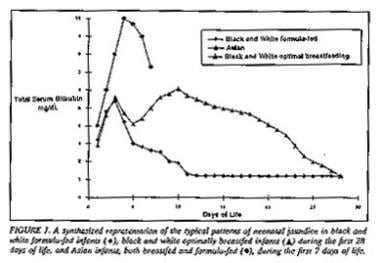
Race: Among infants reported in the US kernicterus registry, 58% were white. Asian and Hispanic babies born either in their native countries or in the United States and Native American and Eskimo infants have higher production levels of bilirubin than white infants. African American infants have lower production levels (see Image 1). The reasons for these racial differences have not been fully elucidated.
Sex: Male infants have consistently higher levels of serum bilirubin than do female infants. Among infants reported in the US kernicterus registry, 67% of the patients were male.
Age: Acute bilirubin toxicity appears to occur in the first few days of life of the term infant. Preterm infants may be at risk of toxicity for slightly longer than a few days. If injury has occurred, the first phase of acute bilirubin encephalopathy appears within the first week of life.
The pilot kernicterus registry data show that, of 116 infants (all >35 weeks' gestational age at birth), symptoms became apparent in 8 babies (7%) aged 3 days or younger and in 85 babies (73%) aged 4-7 days. In 23 babies (20%), symptoms did not appear until after the first week of life. Most of these babies (76%) were term infants (>36 completed weeks’ gestation), and no infant was younger than 35 weeks' estimated gestational age.
History: A history of risk for hemolytic disease can be an important clue to a neonate's increased risk of pathologic hyperbilirubinemia, particularly Rh antigen incompatibility between mother and baby. ABO incompatibility and a family history of red blood cell (RBC) abnormalities (ie, G6PD deficiency, hereditary spherocytosis) are also concerning.
Conversely, if the baby is breastfeeding well and appears healthy and vigorous, this can be reassuring. The mother may have breastfed previous babies who also developed significant jaundice. If so, she may be one of the approximately 20-40% of women who have above-average levels of beta-glucuronidase in their breast milk, which potentiates and prolongs hyperbilirubinemia in their breastfed babies.
Physical: BIND is the term applied to the spectrum of neurologic abnormalities associated with hyperbilirubinemia. It can be further divided into characteristic signs and symptoms that appear in the early stages (acute) compared with those that evolve over a prolonged period (chronic).
- Acute bilirubin encephalopathy: The clinical features of this diagnosis have been well described and can be divided into 3 stages. Of babies with BIND, approximately 55-65% present with these features, 20-30% may display some neurologic abnormalities, and approximately 15% have no neurologic signs.
- Phase 1 (first few days of life): Decreased alertness, hypotonia, and poor feeding are the typical signs. Obviously, these are quite nonspecific and could easily be indicative of a multitude of neonatal abnormalities. A high index of suspicion of possible BIND at this stage that leads to prompt intervention can halt the progression of the illness, significantly minimizing long-term sequelae. Of note, seizure is not typically associated with acute bilirubin encephalopathy. Among infants reported in the US kernicterus registry, the mean birth weight was 3281 g.
- Phase 2 (variable onset and duration): Hypertonia of the extensor muscles is a typical sign. Patients present clinically with retrocollis (backward arching of the neck), opisthotonus (backward arching of the back), or both. Infants who progress to this phase develop long-term neurologic deficits.
- Phase 3 (infants aged > 1 wk): Hypotonia is a typical sign.
- Chronic bilirubin encephalopathy: The clinical features of chronic bilirubin encephalopathy evolve slowly over the first several years of life in the affected infant. The clinical features can be divided into phases; the first phase occurs in the first year of life and consists of hypotonia, hyperreflexia, and delayed acquisition of motor milestones. The tonic neck reflex can also be observed. In children older than 1 year, the more familiar clinical features develop, which include abnormalities in the extrapyramidal, visual, and auditory systems. Minor intellectual deficits can also occur.
- Extrapyramidal abnormalities: Athetosis is the most common movement disorder associated with chronic bilirubin encephalopathy, although chorea can also occur. The upper extremities are usually more affected than the lower ones; bulbar functions can also be impacted. The abnormalities result from damage to the basal ganglia, the characteristic feature of chronic bilirubin encephalopathy.
- Visual abnormalities: Ocular movements are affected, most commonly resulting in upward gaze, although horizontal gaze abnormalities and gaze palsies can also be observed. These deficits result from damage to the corresponding cranial nerve nuclei in the brain stem.
- Auditory abnormalities: Hearing abnormalities are the most consistent feature of chronic bilirubin encephalopathy and can develop in patients who show none of the other characteristic features. The most common abnormality is high-frequency hearing loss, which can range from mild to severe. These deficits can result from damage both to the cochlear nuclei in the brain stem and to the auditory nerve, which appear to be exquisitely sensitive to the toxic effects of bilirubin, even at relatively low levels. Clinically, this deficit can manifest as delayed language acquisition. Hence, auditory function must be assessed early in any baby at risk for chronic bilirubin encephalopathy.
- Cognitive deficits: Cognitive function is relatively spared in chronic bilirubin encephalopathy. However, individuals with chronic bilirubin encephalopathy are often mistakenly considered mentally retarded because of their choreoathetoid movement disorders and hearing deficits. The clinician must emphasize that intellectual functioning is not typically severely affected.
- Abnormalities of dentition: Some degree of dental enamel hypoplasia can be observed in about three quarters of patients with chronic bilirubin encephalopathy. A smaller number of individuals develop green-stained teeth.
Causes: Be familiar with bilirubin metabolism to understand factors leading to an increased risk of kernicterus (see Image 2). Bilirubin is produced during the catabolism of the heme component of red blood cells. Red cell destruction is usually increased in the immediate neonatal period; it can be pathologically elevated in the presence of immune- or nonimmune-mediated hemolytic disease. The first enzyme in the catabolic cascade leading to bilirubin is heme oxygenase. A constitutive form and an inducible form exist, which are induced by physiologic stressors. The creation of bilirubin, a potentially toxic water-insoluble compound, from biliverdin, a nontoxic water-soluble substance, consumes energy.
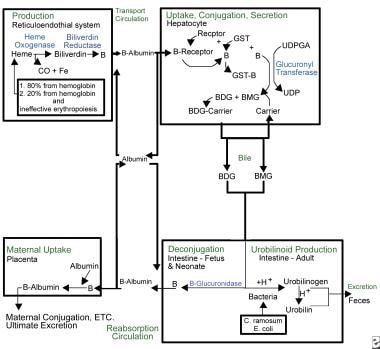
Because of its lipophilic nature, bilirubin must be bound to albumin to travel through the blood stream. In this state, it is not free to cross the blood-brain barrier and cause kernicterus. The albumin-bilirubin complex is carried to the liver, where bilirubin enters the hepatocyte for further metabolism. Once in the liver, bilirubin is conjugated via the action of uridine diphosphate glucuronyl transferase (UDPGT), an enzyme not fully functional until 3-4 months of life.
Conjugated bilirubin is excreted into the intestinal tract via the biliary system. Beta-glucuronidase, present in the intestinal lumen of human neonates, deconjugates the conjugated bilirubin, allowing it to be reabsorbed across the intestinal lipid cell membranes back into the blood stream where it must be re-bound to albumin to repeat the cycle. This process, called enterohepatic recirculation, is a unique neonatal phenomenon and contributes significantly to physiologic jaundice.
To summarize, the body expends energy to convert biliverdin, a nontoxic, water-soluble, easily excreted compound, into bilirubin, a potentially toxic, water-insoluble, difficult-to-excrete product. Multiple mechanisms in the neonate, some of which are initiated by adverse physiologic events, act to promote and preserve the presence of bilirubin. These mechanisms extinguish as the neonate ages.
Among infants reported in the US kernicterus registry, severe hemolytic processes were identified in 22 of 116 babies (19%); glucose-6-phosphate dehydrogenase (G6PD) deficiency was diagnosed in 26 babies (22%), birth trauma identified in 17 patients (15%), and other causes such as galactosemia, Crigler-Najjar syndrome, and sepsis were diagnosed in 8 babies (7%). In 43 of 116 infants (37%), no etiology for the severe hyperbilirubinemia was discovered.
- Increased bilirubin production: Most of the circulating bilirubin in the neonate arises from destruction of circulating RBCs. Neonates produce bilirubin at more than double the daily rate of the average adult, primarily because of the larger circulating volume of RBCs and their shorter life span. Any event resulting in increased serum bilirubin load puts the infant at risk for hyperbilirubinemia.
- Polycythemia: Prenatal factors, such as maternal smoking, maternal illness, placental insufficiency, and gestation at altitude, can result in neonatal polycythemia. Obstetric factors, such as delayed clamping of the cord, stripping the cord, or holding the baby below the level of the introitus for a prolonged period, can result in increased RBC mass in the baby. This is particularly true for babies born in the absence of a trained birth attendant.
- Hemolysis: Immune hemolytic disease, most often Rh isoimmunization (erythroblastosis fetalis), is the prototype etiology for kernicterus. ABO isoimmunization, as well as minor blood group antigens, can also cause hemolytic disease in the newborn, usually of moderate severity. Infants born to mothers of blood type O negative are at greatest risk. Abnormalities of the red cell itself can also predispose to hemolysis. These can be grouped into membrane defects, such as hereditary spherocytosis and elliptocytosis; enzyme defects, such as G6PD deficiency and pyruvate kinase deficiency; and hemoglobinopathies, such as alpha and beta thalassemias. (Sickle cell disease does not typically cause hemolytic disease in the neonatal period.)
- Extravasated blood: Significant areas of bruising, such as severe cephalohematoma or peripheral ecchymoses from birth trauma, can result in an increased bilirubin load in the serum as the blood collection resolves. Internal areas of hemorrhage, such as pulmonary or intraventricular bleeds, can also be a significant occult source of serum bilirubin.
- Enzyme induction: As mentioned previously, heme-oxygenase-one (HO-1) is the inducible form of the first enzyme involved in the creation of bilirubin. This enzyme is activated by physiologic stressors, such as hypothermia, acidosis, hypoxia, and infection.
- Epidemiologic factors: East Asian and Native American babies produce bilirubin at higher rates than do white infants; African American infants have lower production rates than do infants of other racial groups. Male infants have higher serum bilirubin levels than females. Hyperbilirubinemia also runs in families; the etiology is unclear but may relate to genetically increased levels of beta-glucuronidase in the infant, in the mother's breast milk, or both (if the infant breast fed).
- Decreased elimination: Even with normal bilirubin production, abnormalities in transport, excretion, or both can result in an increased level of free bilirubin in the serum.
- Albumin binding
- Because of its lipophilic nature, bilirubin must be bound to carrier protein to be transported in the aqueous environment of the serum. Albumin has one primary high-affinity binding site for bilirubin and two lower-affinity sites. At physiologic pH, the amount of free bilirubin (eg, bilirubin not bound to albumin) is very low. This is important because only free bilirubin is available to cross the blood-brain barrier and cause neurotoxicity. Decreased albumin binding capacity, decreased albumin binding affinity, or both can serve to increase the amount of free serum bilirubin. Binding affinity is lower in neonates than in older infants and is lower still in premature and sick infants than in healthy term ones.
- Decreased binding capacity can occur in hypoalbuminemia or if the binding sites are filled with other anions. Controversy exists regarding whether parenterally administered lipid can displace bilirubin from its albumin-binding site. If faced with dangerously high levels of serum bilirubin, restricting lipid administration to less than maximal levels may be prudent. Drugs, such as sulfisoxazole and ceftriaxone, can also compete for bilirubin-binding sites on the albumin molecule and must be used with caution or avoided in the neonatal period.
- Hepatic uptake and conjugation
- Albumin carries bilirubin to the liver, where it is incorporated into the hepatocyte by an acceptor protein called ligandin. Hepatic levels of ligandin do not reach adult values until around age 5 days, but they can be induced by administration of phenobarbital.
- Once inside the hepatocyte, bilirubin is conjugated to a sugar moiety, glucuronic acid, via the enzyme UDPGT. Inherent neonatal deficiency of this enzyme is the principal etiology of physiologic jaundice. For the first 10 days of life, UDPGT is present at levels about 0.1% of adult values, and hyperbilirubinemia appears to be the primary stimulus to enzyme production.
- Beyond physiologic jaundice, congenital inherited defects in UDPGT cause pathologic hyperbilirubinemia of varying severity. Crigler-Najjar syndrome type I is the virtual absence of UDPGT and is characterized by profound refractory hyperbilirubinemia with the ongoing risk of kernicterus at any point during an individual’s lifespan. Currently, liver transplant is the only definitive therapy, although experimental therapies are under investigation. Patients with Crigler-Najjar syndrome type II (ie, Arias syndrome) have a similar clinical presentation as patients with type I. However, patients with type II respond dramatically to therapy with phenobarbital, which is how the diagnosis is made.
- Gilbert syndrome is characterized by a benign chronic indirect hyperbilirubinemia without evidence of liver disease or abnormality. The genetic basis for this syndrome has recently been identified as an amplified triplet repeat in the coding gene for UDPGT, and investigations are continuing to clarify the possible role of Gilbert syndrome in infants with neonatal hyperbilirubinemia.
- Excretion
- Once conjugated, water-soluble bilirubin is excreted in an energy-dependent manner into the bile canaliculi for ultimate delivery into the small intestine. Disruption in this system or obstruction in the biliary system results in accumulation of conjugated bilirubin in the serum, identified by an elevation in the direct fraction of total bilirubin. Direct hyperbilirubinemia in the neonate (defined as a direct fraction greater than one third of total bilirubin) is always pathologic, and an etiology must be pursued.
- In the small intestine, conjugated bilirubin cannot be reabsorbed. Intestinal florae convert it into urobilinogen, which is excreted. In the neonate, the paucity of colonic bacteria impedes this conversion. Furthermore, the neonatal gut (but not that of the adult) produces beta-glucuronidase, an enzyme that acts upon conjugated bilirubin, releasing free bilirubin for potential absorption across the intestinal cell lipid membrane into the blood stream. Breast milk also contains beta-glucuronidase, and breast milk feedings increase the level of this enzyme in the neonatal intestine. Combined with slow intestinal motility in the first few days of life, the above factors result in what is called enterohepatic recirculation of bilirubin back into the blood stream.
- Systemic factors: Various systemic conditions increase the risk of hyperbilirubinemia and the risk of kernicterus without severe hyperbilirubinemia.
- Galactosemia: Patients with this rare inborn error of metabolism may primarily present with hyperbilirubinemia, although the direct fraction typically increases during the second week of life. The baby may manifest other characteristic signs, such as hepatomegaly, poor feeding, or lethargy. Urine for reducing substances, but not glucose, is diagnostic. Many state newborn metabolic screens include a test for this disorder.
- Hypothyroidism: Although the etiology is unclear, prolonged indirect hyperbilirubinemia is one of the typical features of congenital hypothyroidism, and this diagnosis must be ruled out in any baby with hyperbilirubinemia persisting after age 2-3 weeks. Most state metabolic screens include an assay of thyroid function, although false-negative results and delayed receipt of results may necessitate individual testing in symptomatic infants.
- Drugs: Maternal administration of oxytocin, diazepam, or promethazine may result in increased serum bilirubin in the infant. Similarly, neonatal administration of pancuronium and chloral hydrate increases bilirubin levels. Additionally, some drugs, such as sulfonamides and some penicillins, can displace bilirubin from its albumin-binding site, effectively increasing the serum concentration of free bilirubin available to cross the blood-brain barrier.
- Acidosis: Systemic acidosis decreases the binding affinity of albumin for bilirubin, resulting in increased levels of free bilirubin in the blood stream. Ready availability of protons promotes the formation of bilirubin acid (free bilirubin anion plus 2 hydrogen ions); that moiety demonstrates increased binding and transport into neural cell membranes.
- Disrupted blood-brain barrier: The neonatal blood-brain barrier is more permeable to substances than is the adult's. Administration of hyperosmolar substances, hypercarbia, asphyxia, infection (particularly meningitis), and impaired autoregulation with variations in blood pressure all may weaken capillary tight junctions, increasing capillary permeability. This, in turn, might lower the concentration at which bilirubin is toxic to the CNS.
- Breast milk feedings
- The well-described physiologic jaundice observed in the first few days of life, particularly in the breastfed infant, is called breastfeeding jaundice. Breastfeeding jaundice is thought to result from multiple mechanisms, described above, which promote production and inhibit excretion of bilirubin, as well as from insufficient milk intake because of reduced mammary gland milk production in the first few days postpartum. Breastfeeding jaundice should be distinguished from breast milk jaundice.
- Some breastfed infants, while clinically thriving, continue to manifest an indirect hyperbilirubinemia of unidentifiable etiology for several months. If this is witnessed in a breastfed infant, the exclusion diagnosis of breast milk jaundice may be made. Such hyperbilirubinemia is thought to be caused by persistently high levels of as-yet-unidentified components in some women's breast milk, which result in persistence of the infant's hyperbilirubinemia. One clue may be a history of similar hyperbilirubinemia in other breastfed siblings. This entity is benign.
 | DIFFERENTIALS
| Section 4 of 12  |
Fetal Alcohol Syndrome
Head Trauma
Hearing Impairment
Herpes Simplex Virus Infection
Hyperammonemia
Hypothyroidism
Meningitis, Bacterial
Neonatal Sepsis
Periventricular Leukomalacia
Other Problems to be Considered:
Cerebral palsy
Hypoxic-ischemic brain injury in the newborn
Sepsis
Lab Studies:
- Hematologic studies: Hematologic laboratory evaluation is the cornerstone of evaluation of the baby with hyperbilirubinemia. Although jaundice can be appreciated clinically, observation alone is not a reliable method to assess the severity or estimate risk factors for the infant.
- Total and direct bilirubin: Quantitative measurement of total and direct bilirubin should be undertaken in every baby at risk for significant hyperbilirubinemia or kernicterus. Total bilirubin measures the aggregate of all forms of bilirubin in the serum. The direct fraction measures the amount of conjugated bilirubin. Subtraction of the direct fraction from the total yields the calculated indirect bilirubin, or the unconjugated form. Remember that the indirect fraction is composed of bound bilirubin, free bilirubin, and lumirubin if the baby is under phototherapy. Only the free bilirubin is available to cross the blood-brain barrier and has the potential to cause neurotoxicity. Attempts to measure the amount of bound albumin or to estimate the bound fraction from measures of serum albumin have not proved to be clinically useful.
- Serial measurements may be necessary to track the evolution of hyperbilirubinemia; frequency of measurements depends on the baby's gestational age, chronologic age, risk factors, and other clinical characteristics.
- In infants who were reported on the US kernicterus registry, total serum bilirubin levels ranged from 20.7-59.9 mg/dL at the time of presentation with the classic physical signs of kernicterus.
- Every baby with hyperbilirubinemia should have a direct fraction measured at least once to rule out direct hyperbilirubinemia. Direct hyperbilirubinemia in the neonate is defined as a direct fraction greater than one third of total bilirubin and is always pathologic. Subsequently, if the hyperbilirubinemia is established as the indirect type, obtaining a direct fraction with every measurement is unnecessary unless the hyperbilirubinemia develops after the expected time frame for typical neonatal hyperbilirubinemia.
- With the advent of early discharge (before the physiologic peak of serum bilirubin) some clinicians are advocating universal bilirubin measurements in all babies prior to discharge. Nomograms have been published that estimate a baby's risk of disease based on measured levels of bilirubin. The most recently published nomogram uses an hour-specific approach to address the difficulties posed by babies leaving the hospital within 24-48 hours of birth (see Image 3).
- Blood type: The baby's blood type should be determined and compared with that of the mother. Mothers with blood type O may have circulating antibodies to other red cell antigens that can cross the placenta and cause hemolytic disease in a baby with a different blood type, such as blood type A or B. Similarly, mothers who are Rh negative may have antibody to the Rh antigen if they have not been treated with RhoGAM. Antibody to the Rh antigen causes the most fulminant type of hemolytic hyperbilirubinemia, termed erythroblastosis fetalis in its most severe form. ABO incompatibility can cause significant hemolysis as well. Minor antigens on the baby's RBC are also susceptible to immune-mediated hemolysis from maternally acquired antibody but usually to a lesser extent than the major antigens.
- Reticulocyte count: Babies typically have reticulocyte counts higher than older infants and adults. However, significant elevation in the neonate's reticulocyte count (>7 mg/dL) can indicate the presence of an ongoing hemolytic process.
- Direct Coombs test: This test assays for antibody on the RBC membrane. A positive result indicates that antibodies are attached to the RBC, placing it at risk for immune-mediated destruction. This is a qualitative test, so a positive result does not suggest the amount of antibody or the degree of hemolysis. (However, pairing these results with the reticulocyte count can provide some idea of the severity of the process.) This test, although reliable, does not have 100% sensitivity. Because false-negative results do occur, repeating a test with an initial negative result is not unreasonable if the clinical course supports an ongoing hemolytic process. In a many cases of ABO incompatibility, direct Coombs test findings may be negative. Therefore, an elution test should be performed to demonstrate anti-A or anti-B antibodies in the serum.
- Complete blood cell count: A CBC with manual differential should always be included in the evaluation of a jaundiced newborn. Measurement of the hemoglobin and hematocrit can be helpful to determine if ongoing hemolysis severe enough to cause anemia is present. The peripheral smear inspection is particularly valuable because it may reveal large amounts of nucleated RBCs, suggesting active reticulocytosis; it may show abnormally shaped RBCs in the case of hereditary membrane defects such as spherocytosis and elliptocytosis or marked ovalocytosis in the case of hemolytic disease of the newborn. Babies with sepsis can develop hyperbilirubinemia, and, although not conclusive, normal total white blood cell count and manual differential can be reassuring in a healthy-appearing baby with hyperbilirubinemia.
- Serum electrolytes: Breastfed babies are known to normally develop higher levels of serum bilirubin than their formula-fed counterparts. However, with the trend toward earlier discharge, most breastfed babies are being discharged home before breastfeeding is well established, and a concomitant increase has occurred in the number of babies admitted in the first week of life with hypernatremic dehydration. Many of these babies are also significantly hyperbilirubinemic, and the resurgence of kernicterus from its previous virtual obsolescence is being attributed partly to this situation. Therefore, assessing serum sodium, potassium, chloride, bicarbonate, BUN, and creatinine levels is essential; initiate treatment as appropriate.
- Lumbar puncture: In the initial evaluation of hyperbilirubinemia, sepsis may be included in the differential diagnosis. If so, collection of spinal fluid for culture and cell count should be considered to rule out meningitis. If the baby is having neurologic symptoms, cerebral spinal fluid (CSF) evaluation is imperative; depending on the baby's symptoms, expanding the evaluation beyond the normal aerobic bacterial culture may be prudent. If, on the other hand, the baby is vigorous and well-appearing with isolated hyperbilirubinemia as the only symptom, a spinal tap may not be necessary.
- Transcutaneous bilirubin measurement: Recently, a number of devices that transcutaneously measure total serum bilirubin levels have become commercially available. These devices have been tested in babies of varying ethnicities, skin pigmentations, and gestational ages. Correlation with serum bilirubin measurements is generally good. Although this approach is not recommended to replace the criterion standard of serum measurement, it may be a useful adjunct to the clinical management of hyperbilirubinemia in the term and/or preterm infant.
Imaging Studies:
- In the acute phase of bilirubin encephalopathy, neuroimaging has no major diagnostic benefit. However, it can help rule out other diagnoses, particularly in the absence of profound hyperbilirubinemia.
- Head ultrasonography (HUS): This modality is particularly well suited to the neonate because it is painless, portable, and noninvasive; also, the neonatal brain is easily imaged through the fontanelles. Sonographic imaging is not helpful in diagnosing acute bacterial encephalopathy; however, other entities, such as intraventricular hemorrhage or parenchymal abnormalities, can be ruled out.
- CT scanning: Computed tomography scanning has little place in the evaluation of the neonatal brain. It is difficult to perform because the baby must be transported to the radiology department and must be heavily sedated for the procedure. The subtle abnormalities often present in the neonatal period are not well visualized by CT scanning, and false-negative findings are not uncommon.
- MRI: Previously, the neuronal damage characteristic of kernicterus was thought to only be identifiable on histologic examination postmortem. However, experience has revealed that MRI can be used to depict characteristic bilateral symmetric high-intensity signals in the globus pallidus on both T1- and T2-weighted images in patients surviving with chronic bilirubin encephalopathy (see Image 4). The usefulness and cost-effectiveness of this modality in the diagnosis of more subtle forms of BIND remains to be fully elucidated.
Other Tests:
- Brainstem auditory evoked response (BAER): Hearing impediment is the most common sequela of bilirubin toxicity. Impairment may be subtle and may not be clinically apparent until the baby manifests delayed language acquisition. To maximize the baby's long-term neurologic functioning, early identification of any degree of hearing loss is important so that early developmental assessment and intervention can be initiated in a timely fashion. Serial assessments of hearing function may be necessary.
Histologic Findings: On macroscopic examinations, characteristic yellow staining can be readily observed in fresh or frozen sections of the brain obtained within 7-10 days after the initial bilirubin insult. The regions most commonly involved include the basal ganglia, particularly the globus pallidus and subthalamic nucleus; the hippocampus; the substantia nigra; cranial nerve nuclei, including the oculomotor, cochlear, and facial nerve nuclei; other brainstem nuclei, including the reticular formation and the inferior olivary nuclei; cerebellar nuclei, particularly the dentate; and the anterior horn cells of the spinal cord.
Neuronal necrosis occurs later and results in the clinical findings consistent with chronic bilirubin encephalopathy. Histologically, this appears as cytoplasmic vacuolation, loss of Nissl substance, increased nuclear density with haziness to the nuclear membrane, and pyknotic nuclei (see Image 5).
 | TREATMENT
| Section 6 of 12  |
Medical Care: The cornerstone of management of hyperbilirubinemia is prevention of neurotoxicity. The definitive method of removing bilirubin from the blood is via exchange transfusion. This is currently the indicated approach in the presence of clinical BIND when the bilirubin level has reached dangerous levels despite preventive efforts. Phototherapy is the most common method aimed at prevention of bilirubin toxicity. Current clinical research is evaluating the use of metalloporphyrins to block bilirubin formation by competing with the enzyme heme oxygenase.
- Exchange transfusion: This definitive therapy is used to mechanically remove already-formed bilirubin from the blood. It is indicated whenever clinical signs of acute bilirubin encephalopathy exist in patients who present with critically high serum bilirubin (eg, >25 mg/dL) and dehydration or when the serum bilirubin level continues to rise despite attempts to reduce it. In the presence of Rh isoimmunization, a cord bilirubin level greater than 5 mg/dL or a rate of rise in serum bilirubin greater than 0.5-1 mg/dL/h has been shown to be predictive of the ultimate need for exchange transfusion. This relationship has not been demonstrated in hyperbilirubinemia of other etiologies.
This procedure is not without risk. A report of supplemental intravenous fluid administration in 74 term babies with nonhemolytic severe hyperbilirubinemia (total serum bilirubin level, 18-25 mg/dL) showed a decreased rate of exchange transfusion in babies receiving the extra fluid (16%) compared with controls (54%).
- Technique: The procedure involves removing the baby's native blood and replacing it with CPD (citrate phosphate dextrose) banked blood that does not contain bilirubin. Obviously, this must be performed gradually. Using an estimate of 80-90 mL/kg total blood volume, double this amount is usually removed and replaced sequentially in aliquots (10-15 mL in term babies; 5-10 mL in smaller preterm babies) over several hours. This approach, called a double volume exchange transfusion, harvests the most efficient amount of bilirubin from the blood for the amount of intervention and results in a decrease in total serum bilirubin levels by about 40%. Because of ongoing pathology and equilibrium between the intravascular and extravascular spaces, having to repeat the procedure at least once is not uncommon. Using O negative blood rather than the baby's blood type is important because not all circulating antibodies may be removed. Packed RBCs resuspended in fresh frozen plasma must be used for this procedure.
- Risks
- This procedure carries both inherent risks and iatrogenic ones and should be carefully performed. The reported overall mortality rate is about 3:1000; the risk of significant morbidity has been reported at about 5:100. In very ill babies, the risks are higher. One series of 25 ill infants reported a mortality rate of 20%.
- A review of 183 exchange transfusions performed in 165 neonates in Bangkok, Thailand, between1994 and 2003 reported an overall morbidity of 15.3%, of which 67% was attributed to infection associated with the procedure. Infants who were sick at the time of the procedure (31.3%) were more likely to develop complications than were infants who were basically healthy but hyperbilirubinemic (6.8%). Preterm infants who required exchange transfusion also developed procedure-related complications of anemia, apnea, and cardiac arrest; overall, preterm infants who were basically healthy were more likely to develop some morbidity than were full-term infants treated similarly. Morbidities were identified in sick infants at the same rate regardless of gestational age (preterm vs term). No mortalities were reported.
- Transfusing with banked blood products carries a risk of infection. Currently, the risk of infection with known pathogens is exceedingly small. However, a risk of infection with pathogens that have not yet been discovered (ie, most recently hepatitis C) continues.
- During the procedure, continually monitor for attendant physiologic aberrations, such as hypoglycemia, thrombocytopenia, hyperkalemia (particularly if the banked blood is older than 5 d), and hypocalcemia (if ethylenediamine tetra-acetic acid [EDTA] preservative is used in the banked blood).
- Mechanical issues can contribute to the overall mortality and morbidity of the procedure. The need for central access, catheter- and infusion-related problems, and human error during infusion are all areas that can pose potentially significant risk.
- Since the advent of phototherapy and obstetric treatment of Rh disease, the need for exchange transfusion has diminished.
- Indicated bilirubin levels
- As mentioned above, no clear-cut level of bilirubin exists above which encephalopathy is assured and below which neurologic safety exists. Birthweight, gestational age, and chronologic age are all important, as are a baby's systemic condition, fluid and nutritional status, acid-base status, and the presence or absence of known pathology. In 2004, the AAP published revised practice parameters for the management of hyperbilirubinemia in healthy infants aged 35 weeks’ or more estimated gestational age. In this document, the AAP presented recommendations for exchange transfusion for serum bilirubin levels greater than 20-25 mg/dL, depending on the postconceptional age of the infant and the bilirubin-to-albumin ratio, a tool that is not widely incorporated into the decision algorithm.
- Studies have reported neurologically normal outcomes in healthy term infants with histories of serum bilirubin levels as high as 46 mg/dL. However, the recent resurgence in kernicterus has been reported to occur in near-term infants with serum bilirubin levels as low as 20.7 mg/dL. The level at which to intervene is a clinical question that remains to be answered. The procedure should be highly considered in babies with significant risk factors predisposing for kernicterus (eg, sepsis, acidosis, hemolytic disease) if the bilirubin level has approached the 20- to 25-mg/dL range.
- Enteral interventions: Administration of agar has been tried in an attempt to decrease the enterohepatic recirculation of conjugated bilirubin. It has not proved to be clinically useful and may cause intestinal obstruction.
- Accelerated meconium evacuation: Administration of glycerin suppositories to facilitate stooling has been evaluated as a potential method of ameliorating hyperbilirubinemia. Although a controlled trial demonstrated earlier passage of meconium, no effect was demonstrated on total serum bilirubin levels, except for a small statistically significant effect identified in males with blood type A positive. Whether this was a statistical aberration or a true treatment effect is unclear.
- Beta-glucuronidase inhibition: L-aspartic acid and enzymatically hydrolyzed casein (EHC) are known inhibitors of beta glucuronidase, the enzyme that promotes enterohepatic recirculation of conjugated bilirubin in the neonatal intestine. A randomized controlled trial of enteral administration of these substances (2 treatment groups) compared with babies who received nothing (group 3) or enteral whey/casein (no known enzymatic activity, group 4) showed significantly lower transcutaneous bilirubin measurements in breastfed babies aged 3-7 days who received the enzyme inhibitors when compared with the controls. However, a similar treatment effect observed in group 4 raises some questions regarding the value of these therapies.
- Sn-mesoporphyrin: Experimental therapy with Sn-mesoporphyrin inhibits bilirubin production by interfering with heme-oxygenase, an essential enzyme in the catabolic pathway of hemoglobin. This therapy is in clinical trials but has not been approved for use by the Food and Drug Administration (FDA). A report of a single case of compassionate use in the United States in a very low birth weight infant with severe growth restriction who was not a candidate for exchange transfusion showed a more than 25% reduction in total serum bilirubin levels after administration of a single dose at 46 hours of life. Although more extensively studied in other countries, the safety and possible long-term sequelae of this therapeutic modality remain to be elucidated.
Surgical Care: Stable central venous access is required to successfully perform an exchange transfusion. Surgical placement of appropriate lines may be required to facilitate this procedure.
Consultations: Obtaining input from a pediatric neurologist during the acute presentation of BIND may be useful. However, the history and clinical presentation may make the diagnosis apparent.
In the chronic phase, involving neurodevelopmental specialists in the care and evaluation of the infant is important. Developmental potential can be maximized by early identification of and intervention for neurologic deficits.
If the patient develops hydrocephalus, consultation with a neurosurgeon is recommended.
Diet: Depending on the degree of neurologic impairment, infants or children may have limitations in their ability to eat normally. Diet and nutrition must be individualized with the help of the neurodevelopmental team caring for the patient.
Activity: Some neurologic deficits typically appear during the phase of motor skill acquisition by the infant. Motor deficits should be identified early, and appropriate intervention should be initiated to maximize the infant's ability in this critical area.
 | MEDICATION
| Section 7 of 12  |
No medications are available to treat the symptoms of acute or chronic bilirubin encephalopathy. Pharmacologic intervention is aimed at prevention. Current therapies are indicated as adjuncts to phototherapy when total bilirubin is approaching exchange level; experimental therapy continues with the use of bilirubin production inhibitors.
Drug Category: Blood product derivatives -- These methods decrease the amount of free bilirubin in the intravascular space, thus theoretically reducing the risk of neurotoxicity. Bilirubin is produced via induction of its enzymatic pathway and by RBC degradation. Inhibition of either of those 2 mechanisms can decrease the amount of bilirubin in the blood.
Drug Name
| Albumin (Albuminar, Albunex, Albumisol, Buminate) -- Because bilirubin bound to albumin is not available to cross the blood-brain barrier, increasing the amount of serum albumin theoretically increases the amount of available binding sites and decreases free bilirubin. Efforts to quantify albumin-binding capability or serum levels of bound bilirubin have not proved to be clinically useful, although assessment of the bilirubin-to-albumin ratio has recently been incorporated into the decision-making algorithm for exchange transfusion. However, administration of albumin for the purpose of increasing bilirubin-binding capacity is not a recommended standard of care. It may be considered in cases of significant hypoalbuminemia. Measured albumin levels <3 g/dL may be considered an additional risk factor for BIND when considering therapeutic interventions. |
|---|
| Pediatric Dose | 0.5-1 g/kg IV of 5% albumin (ie, 5 g/100 mL) |
|---|
| Contraindications | Documented hypersensitivity; pulmonary edema; severe anemia; cardiac failure |
|---|
| Interactions | None reported |
|---|
|
Pregnancy
|
C - Safety for use during pregnancy has not been established.
|
| Precautions | Use 25% albumin with caution in premature neonates because of the increased risk of intraventricular hemorrhage; caution in renal or hepatic failure, may cause protein overload; rapid infusion may cause vascular overload or hypotension; monitor for volume overload; caution in sodium-restricted patients; common adverse effects include CHF, hypotension, tachycardia, fever, chills, and pulmonary edema; do not dilute albumin 25% with sterile water for injection (produces hypotonic solution and, if administered, may result in life-threatening hemolysis and acute renal failure) |
|---|
Drug Name
| Immune globulin intravenous (Gamimune, Gammagard, Sandoglobulin) -- Parenteral administration has been shown in controlled clinical trials to reduce the need for exchange transfusion in both Rh and ABO immune-mediated hemolytic disease. Its mechanism of action is not entirely clear.
Administration in hyperbilirubinemia resulting from isoimmune hemolytic disease that is unresponsive to phototherapy and/or is approaching exchange level has been recommended by the AAP in its 2004 revised clinical practice guideline. |
|---|
| Pediatric Dose | 0.5-1 g/kg IV, administered over 2 h; the dose can be repeated in 12 h, if needed |
|---|
| Contraindications | Documented hypersensitivity; IgA deficiency |
|---|
| Interactions | Globulin preparation may interfere with immune response to live virus vaccine (MMR) and reduce efficacy (do not administer within 3 mo of vaccine) |
|---|
|
Pregnancy
|
C - Safety for use during pregnancy has not been established.
|
| Precautions | Associated with other risks accompanying administration of other human blood products (eg, transmission of infection, allergic reaction); unknown if administration of IVIG places the neonate at a theoretically increased risk of susceptibility to infection; check serum IgA before IVIG (use an IgA-depleted product, eg, Gammagard S/D); infusions may increase serum viscosity and thromboembolic events; infusions may increase risk of migraine attacks, aseptic meningitis (10%), urticaria, pruritus, or petechiae (2-30 d postinfusion) |
|---|
Drug Category: Anticonvulsant agents -- Phenobarbital may increase hepatic conjugation and excretion. Decreased hepatic conjugation caused by normal delay in enzyme induction increases the amount of unconjugated bilirubin in the blood stream. Conjugated bilirubin does not pose a threat of neurotoxicity. Once conjugated, this nontoxic form of bilirubin proceeds toward intestinal excretion.Drug Name
| Phenobarbital (Luminal, Solfoton) -- Induces the hepatic enzymes involved in bilirubin conjugation and increases biliary excretion.
Do not administer intra-arterially. Dosing can be enteral or parenteral. Maximum IV administration rate of 1 mg/kg/min IV; not to exceed 30 mg/min for infants. |
|---|
| Pediatric Dose | Hyperbilirubinemia: 3-8 mg/kg/d PO/IV initially; may increase up to 12 mg/kg/d |
|---|
| Contraindications | Documented hypersensitivity; severe respiratory disease; marked impairment of liver function; nephritis |
|---|
| Interactions | May decrease effects of chloramphenicol, digitoxin, corticosteroids, carbamazepine, theophylline, verapamil, metronidazole, and anticoagulants (patients stabilized on anticoagulants may require dosage adjustments if added to or withdrawn from their regimen); coadministration with alcohol may cause additive CNS effects and death; chloramphenicol, valproic acid, and MAOIs may increase phenobarbital toxicity; rifampin may decrease phenobarbital effects; induction of microsomal enzymes may result in decreased effects of PO contraceptives in women (must use additional contraceptive methods to prevent unwanted pregnancy; menstrual irregularities may also occur) |
|---|
|
Pregnancy
|
D - Unsafe in pregnancy
|
| Precautions | Use with caution in patients with renal impairment, hepatic impairment, or both; abrupt withdrawal may precipitate status epilepticus; high doses may cause respiratory depression or failure |
|---|
 | FOLLOW-UP
| Section 8 of 12  |
Further Inpatient Care:
- Phototherapy induces a conformational change in the bilirubin molecule, rendering it water-soluble. Formation of lumirubin is irreversible, whereas the formation of other water-soluble isomers is reversible upon cessation of phototherapy. Postphototherapy rebound is a well-recognized phenomenon that must be considered in all patients receiving phototherapy for hyperbilirubinemia due to a hemolytic process or prematurity. One series of 226 term and near-term neonates treated in Israel between January 2001 and September 2002 reported significant rebound hyperbilirubinemia in 13.3% of patients. Risk factors of excessive rebound included a positive direct Coombs test and less than 37 weeks’ gestational age.
Further Outpatient Care:
- To help insure that infants may reach their maximum neurodevelopmental potential, referring babies with BIND to a neurodevelopmental pediatrician skilled in caring for these patients is important. Early identification of and intervention for neurodevelopmental deficits has been shown to positively impact an infant's long-term neurodevelopmental prognosis.
- The numerous areas of uncertainty surrounding the diagnosis and treatment of hyperbilirubinemia in the infant, coupled with the infrequency of sequelae, make it easy to become cavalier about the evaluation of a jaundiced infant. However, remember that physiologic hyperbilirubinemia is a diagnosis of exclusion, and kernicterus, when it occurs, is a devastating and legally indefensible sequela.
- Sepsis must always be excluded in the jaundiced infant. Uncommon, but treatable, metabolic causes of jaundice include hypothyroidism and galactosemia. The first sign of occult immune or nonimmune hemolytic disease may be hyperbilirubinemia.
- In its 2004 clinical practice guideline, the AAP included recommendations regarding interval between hospital discharge and outpatient follow-up evaluation by a qualified health care professional. Recommendations are based on the infant's age (in hours of life) at discharge, presence or absence of risk factors for exaggerated hyperbilirubinemia, and the presence of other neonatal problems. Recommendations for follow-up range from as early as prior to 72 hours of life (if discharged before 24 h) to no later than 120 hours (5 d) if discharged before 72 hours.
Transfer:
- The recently reported cases of kernicterus have occurred in near-term or term infants who were discharged from the hospital fewer than 48 hours after birth. Most infants discharged at fewer than 72 hours after birth have clearly not reached their physiologic peak bilirubin level prior to discharge. Any infant at risk for significant hyperbilirubinemia and possible neurotoxicity should be cared for in a nursery capable of rendering appropriate care for the hyperbilirubinemia and any contributing diagnoses. A recently published nomogram predicts which babies may be at risk for significant disease, based on hour-of-life–specific bilirubin levels (see Image 3). Infants whose levels fall in the high-intermediate and high-risk zones should be closely monitored in a nursery capable of caring for sick newborns; they may require transfer from the birth hospital to a regional perinatal center.
Deterrence/Prevention:
- Prevention: Prevention of hyperbilirubinemia is the best way to minimize the incidence of kernicterus. However, because some babies develop kernicterus with relatively modest bilirubin levels, no known absolute level of bilirubin exists below which the infant is completely safe. Additionally, because other factors contribute to the ability of bilirubin to cross the blood-brain barrier, management of these components must be appropriately considered.
- Serum bilirubin: Total serum bilirubin comprises a conjugated fraction (loosely called direct bilirubin) and an unconjugated fraction (indirect bilirubin). They are additive. However, the indirect fraction is composed of bound bilirubin (bound to albumin), lumirubin if the baby is under phototherapy (unbound but water-soluble and unlikely to cross the blood-brain barrier), and free bilirubin. The free component is potentially toxic, but its exact serum level cannot be readily measured.
- Risk of reduction of serum bilirubin
- The current level of knowledge does not recognize the physiologic benefits of bilirubin, despite the multiple mechanisms operant in the neonate to promote and preserve hyperbilirubinemia. In vitro experiments have demonstrated a potent antioxidant capability of bilirubin, more so than the currently identified mechanisms.
- An emerging field of research in human medicine is the role of oxidative injury in the development of various pathologic processes, which may be contributory to many neonatal diseases, such as retinopathy of prematurity, periventricular leukomalacia, bronchopulmonary dysplasia, and necrotizing enterocolitis. Recent observational studies in the neonate have demonstrated an inverse correlation between peak serum bilirubin levels and the development of these various pathologies. Investigation into this line of research continues.
- Phototherapy
- Irradiance with light in the blue-green spectrum (440-480 nm) induces a photochemical reaction that changes the bilirubin molecule into other photoisomers that are water-soluble, readily excretable, and unlikely to cross the blood-brain barrier into the lipid-rich neuronal tissue. Such conversion begins immediately upon exposure of the skin surface to the light.
- The most important photoreaction is an irreversible structural isomerization of bilirubin into a water-soluble substance called lumirubin, which is then excreted in the bile. Reversible configurational isomerization and photo-oxidation also contribute somewhat to the effectiveness of phototherapy to reduce free bilirubin in the baby.
- To be effective, adequate skin surface must be exposed to the appropriate wavelength, with enough intensity (lux) to induce the desired reaction. The AAP has recently included recommendations for wavelength (430-490 nm) and irradiance (>30 mW/cm2) in their clinical practice guideline.
- Serum bilirubin levels should be closely monitored during phototherapy. A 1- to 2-mg/dL decrease of measured bilirubin levels over a 4- to 6-hour period is an appropriate response to phototherapy. If an inadequate response has been observed, lining the baby's bedding with aluminum foil or white material can increase the surface area of exposure and may increase the effectiveness of phototherapy.
- Various devices are commercially available to facilitate provision of phototherapy. Models include overhead lights, blankets, and swaddling devices; selection is based on abilities to cover a broad surface area, ease of administration, and personal preference.
- In 2004, the AAP revised its clinical practice guideline for the management of hyperbilirubinemia in the healthy infant older than 35 weeks' estimated gestational age. The guideline incorporates a nomogram that delineates serum bilirubin levels by hour of life with subsequent risk for significant disease (see Image 3).
- This reference should be used when deciding how closely to monitor babies being discharged home before their bilirubin levels have peaked. Since its development, some experts have recommended universal bilirubin screening (performed with the state metabolic screen to minimize blood draws) before discharge.
- Although falling short of recommending universal bilirubin measurement, the AAP guideline does recommend assessment of risk of severe hyperbilirubinemia in every baby prior to hospital discharge. This assessment can include either a bilirubin measurement (serum or transcutaneous), a clinical assessment of risk factors, or a combination of these 2 approaches.
- Current quantization of bilirubin has been limited to direct serum measurement. Transcutaneous measurement devices have recently become commercially available and are slowly being integrated into clinical use. The manufacturers claim excellent reliability and validity in babies of all skin types and colors.
- Risks of phototherapy
- Phototherapy by itself is generally considered safe in babies, except in some rare genetic skin disorders and congenital porphyria. However, some risks are associated with its use.
- Exposure to phototherapy causes relaxation of the peripheral vasculature, which can increase insensible fluid loss and lead to dehydration, especially in babies in open warmers. This, in turn, potentiates hyperbilirubinemia.
- Some extremely premature infants have reportedly experienced skin burns from fiberoptic blankets on which they were lying. Such devices should be used cautiously in infants with vulnerable skin.
- Concern exists about the risk of retinal damage in infants exposed to the extremely bright light of phototherapy. Accordingly, all infants should wear protective eye coverings while being treated.
- An observed increase in the prevalence of patent ductus arteriosis (PDA) has been shown to occur in premature infants receiving phototherapy, and foil shields to the chest have been shown to ameliorate this increase. The operant mechanism has not been elucidated fully but is thought to be related to the relaxation response observed in these babies' peripheral vascular beds.
- Bilirubin photosensitizes the skin, and skin damage is a theoretical risk. Bullous eruptions have been described in several infants with porphyrin abnormalities; congenital porphyria is a contraindication to the use of phototherapy.
- Bronze baby syndrome occurs in infants with direct hyperbilirubinemia who are exposed to phototherapy. This seems likely to be the result of dermal accumulation of coproporphyrins. Measurement of the direct fraction of total bilirubin should be performed in every baby before starting phototherapy.
- Phototherapy can interfere with maternal-child bonding at a critical time in the dyad's development. If a mother is breastfeeding, initiation of phototherapy introduces mechanical barriers to the breastfeeding process, which can be overwhelming at this critical time. Any comments about the role of breast milk in the development of hyperbilirubinemia may further sabotage this process. Altered parental perceptions of their infant from healthy to ill may further influence their short- and long-term interactions with their infant.
- Phototherapy may be associated with ileus and/or feeding intolerance in premature infants treated with overhead (but not fiberoptic) devices. Doppler flow studies of splanchnic blood flow performed on babies receiving overhead phototherapy showed increased resistance to flow in the superior mesenteric artery (SMA) compared with prephototherapy measurements; no such effect was observed in babies being treated with fiberoptic devices. A retrospective review of 52 consecutive extremely low birth weight infants showed a higher incidence of ileus (abdominal distention, bilious aspirates) in babies receiving phototherapy (63.4%) compared with those who did not (9%). Outcomes between the 2 groups were comparable.
- Breastfeeding: The link between hyperbilirubinemia and breastfeeding has long been recognized, and, until recently, breastfeeding was typically interrupted in the jaundiced infant. Randomized controlled trials have shown that offering formula or dextrose water to the jaundiced breastfed infant actually increases total serum bilirubin levels and, thus, should not be advocated. The AAP recommends against this practice, with evidence quality B and C in its 2004 clinical practice guideline. Furthermore, this practice has also been shown to result in a decrease in breast milk intake after breastfeeding is reestablished. Study of the effect of continuing breastfeeding versus its interruption has not shown any untoward effect of continued breastfeeding. Because of the clear short- and long-term advantages to the infant of breast milk feeds, the evidence would indicate that breastfeeding should be continued in the infant who is well enough to have enteral feedings.
Complications:
- The complications of acute bilirubin encephalopathy encompass the classic scope of chronic bilirubin encephalopathy described above. Abnormalities can be expected in the extrapyramidal system and in auditory and gaze function; dental dysplasia can be expected.
Prognosis:
- The spectrum of neurologic disability from kernicterus can range from mild to severe. Attempts to correlate features of hyperbilirubinemia with prognosis for disability have failed. Despite multiple attempts, no definitive association has been identified between the degree of deficit and parameters such as total serum bilirubin level, duration of hyperbilirubinemia, presence of hemolytic disease, gestational age, birthweight, or concomitant systemic illness.
Patient Education:
- To facilitate the provision of appropriate evaluation and follow-up for babies without recognized risk factors, the AAP has published an hour-of-age-specific guideline that correlates total serum bilirubin levels with degree of risk and recommendations for follow-up.
The AAP recommends professional medical evaluation in 2-3 days for babies who are discharged from the hospital fewer than 48 hours after birth. Babies discharged fewer than 72 hours after birth may also be at risk, and they should be closely monitored as well. Other risk factors warranting additional vigilance may include unexplained family history of neonatal hyperbilirubinemia, near-term gestation, low birth weight, excessive bruising or hematomata, and ethnicity at risk for exaggerated hyperbilirubinemia.
Parents should be informed of the importance of keeping these appointments, as well as be familiarized with the symptoms of poor feeding in breastfed babies and how to seek help.
- For excellent patient education resources, visit eMedicine's Children's Health Center and Procedures Center. Also, see eMedicine's patient education articles Newborn Jaundice and Spinal Tap.
 | MISCELLANEOUS
| Section 9 of 12  |
Medical/Legal Pitfalls:
- Theoretically, most cases of kernicterus may be completely prevented by initiation of phototherapy in every baby shortly after birth. Therefore, this devastating neurologic disease could be prevented most of the time. As such, a significant component of medicolegal liability is introduced into the management of hyperbilirubinemia. Clinical reports of kernicterus in the absence of profound hyperbilirubinemia, coupled with the lack of definitive standards of care for the initiation of phototherapy, further complicate this exposure. As with all medical care, conformity with published clinical guidelines, rationale for departure from accepted clinical norms, and good documentation are the best defenses.
- The numerous areas of uncertainty surrounding the diagnosis and treatment of hyperbilirubinemia in the infant, coupled with the infrequency of sequelae, foster a cavalier attitude about the evaluation of a jaundiced infant. However, remembering that physiologic hyperbilirubinemia is a diagnosis of exclusion is important, and kernicterus, when it occurs, is devastating. Therefore, failure to evaluate or provide reasonable follow-up of infants at risk for the development of severe hyperbilirubinemia may place the clinician in a position that could be difficult to defend.
- Definitive recommendations from the AAP regarding in-hospital evaluation and treatment for hyperbilirubinemia, as well as interval and methodology for outpatient follow-up, while providing useful clinical parameters, also now forms a standard of care against which individual patient care may be judged. Many hospitals have developed clear documents that outline the standard for evaluation and treatment of hyperbilirubinemia, and some of these risk-management approaches have appeared in the medical literature.
- Sepsis must always be excluded in the jaundiced infant. Uncommon, but treatable, metabolic causes of jaundice include hypothyroidism and galactosemia. The first sign of occult immune or nonimmune hemolytic disease may be hyperbilirubinemia. Failure by the clinician to diagnose an underlying etiology results in considerable medicolegal exposure.
 | TEST QUESTIONS
| Section 10 of 12  |
CME Question 1: A white male infant of 35 weeks’ estimated gestational age (EGA) who is now aged 3 days has been breastfeeding well. This morning, however, he is lethargic, is not feeding well, and is notably jaundiced. Which of the following is not an appropriate next step?
A: Initiate a sepsis evaluation because the baby's symptoms could be the result of a developing infection.
B: All babies, especially breastfed ones, become jaundiced by the time they are aged 3 days. Discharge the baby home with outpatient follow-up in one week.
C: Obtain a total and direct serum bilirubin level and consider initiating phototherapy.
D: Check maternal history for her blood type and antibody status.
E: Ensure that the state metabolic screen includes tests for hypothyroidism and galactosemia and that it has been sent as required. Consider repeating those tests now.
The correct answer is B: Physiologic jaundice is a diagnosis of exclusion. All of the other answers include diagnoses that must be excluded before declaring the baby well enough to be discharged.
CME Question 2: Which of the following statements is correct?
A: Kernicterus was a common entity in the 1950s and 1960s, but it has been eradicated in this era of modern neonatal care.
B: Chronic bilirubin encephalopathy occurs if the total serum bilirubin level rises above 25 mg/dL.
C: With the advent of phototherapy, exchange transfusions are no longer indicated in the management of acute hyperbilirubinemia.
D: A negative Coombs test result effectively rules out the diagnosis of hemolytic disease in a newborn.
E: None of the above is correct.
The correct answer is E: Although its incidence is markedly reduced, kernicterus has reappeared on the clinical scene in the last 10 years. Reports have been published of babies with kernicterus who never manifested particularly high serum bilirubin levels; conversely, kernicterus does not occur universally in the presence of extremely high levels (>30 mg/dL). Although usually the initial therapeutic approach, phototherapy is not always effective, and exchange transfusion is still the definitive therapy for fulminant or refractory hyperbilirubinemia, with or without encephalopathy. Although highly reliable, the Coombs test is not 100% sensitive, and false-negative results do occur.
Pearl Question 1 (T/F): Kernicterus universally occurs when the indirect bilirubin level exceeds 20 mg/dL.
The correct answer is False: No level of bilirubin exists above which neurologic damage is certain, and no level exists below which neurologic safety is assured.
Pearl Question 2 (T/F): A breastfed white or Asian male newborn whose siblings had obvious jaundice is most likely to develop significant hyperbilirubinemia.
The correct answer is True: Hyperbilirubinemia is more prevalent in people with lightly pigmented skin. Breast milk promotes the retention of serum bilirubin through a number of different mechanisms. Some women have additional currently unidentified components in their breast milk that further exacerbate normal breast milk jaundice; because experienced breastfeeding mothers tend to breastfeed subsequent children, jaundice tends to run in families.
Pearl Question 3 (T/F): AB positive is the maternal blood type most frequently associated with hemolytic disease in the newborn.
The correct answer is False: O negative is the maternal blood type most commonly associated with hemolytic disease in the newborn because mothers with this blood type are antigenically naive and are most likely to have antibodies to the major red blood cell antigens A, B, and D (Rh).
Pearl Question 4 (T/F): Hypothyroidism and galactosemia are 2 metabolic diseases that can manifest with hyperbilirubinemia, cause devastating neurologic damage if unrecognized, and are easily treatable if identified early.
The correct answer is True: Extremely uncommon but treatable causes of jaundice include the metabolic derangements hypothyroidism and galactosemia. Similarly, the first sign of occult immune or nonimmune hemolytic disease may be hyperbilirubinemia. Failure by the clinician to diagnose a potentially treatable underlying etiology for hyperbilirubinemia may result in considerable medicolegal exposure.
 | PICTURES
| Section 11 of 12  |
 | BIBLIOGRAPHY
| Section 12 of 12 |
-
AAP: Management of hyperbilirubinemia in the newborn infant 35 or more weeks of gestation. Pediatrics 2004 Jul; 114(1): 297-316[Medline].
-
Ahlfors CE, Wennberg RP: Bilirubin-albumin binding and neonatal jaundice. Semin Perinatol 2004 Oct; 28(5): 334-9[Medline].
-
AlOtaibi SF, Blaser S, MacGregor DL: Neurological complications of kernicterus. Can J Neurol Sci 2005 Aug; 32(3): 311-5[Medline].
-
Bader D, Yanir Y, Kugelman A, et al: Induction of early meconium evacuation: is it effective in reducing the level of neonatal hyperbilirubinemia? Am J Perinatol 2005 Aug; 22(6): 329-33[Medline].
-
Barefield ES, Dwyer MD, Cassady G: Association of patent ductus arteriosus and phototherapy in infants weighting less than 1000 grams. J Perinatol 1993 Sep-Oct; 13(5): 376-80[Medline].
-
Bhutani VK, Johnson L, Sivieri EM: Predictive ability of a predischarge hour-specific serum bilirubin for subsequent significant hyperbilirubinemia in healthy term and near-term newborns. Pediatrics 1999 Jan; 103(1): 6-14[Medline][Full Text].
-
Bhutani VK, Johnson LH, Jeffrey Maisels M, et al: Kernicterus: epidemiological strategies for its prevention through systems-based approaches. J Perinatol 2004 Oct; 24(10): 650-62[Medline].
-
Bhutani VK, Donn SM, Johnson LH: Risk management of severe neonatal hyperbilirubinemia to prevent kernicterus. Clin Perinatol 2005; 32 (1): 125 - 39, vii[Medline].
-
British Paediatric Surveillance Unit: Surveillance of severe hyperbilirubinaemia in the newborn commenced the May. BPSU Quarterly Bulletin 2003; 11(2): 2.
-
Cashore WJ: Bilirubin and jaundice in the micropremie. Clin Perinatol 2000 Mar; 27(1): 171-9, vii[Medline].
-
Dennery PA: Metalloporphyrins for the treatment of neonatal jaundice. Curr Opin Pediatr 2005 Apr; 17(2): 167-9[Medline].
-
Drummond GS, Kappas A: Chemoprevention of severe neonatal hyperbilirubinemia. Semin Perinatol 2004 Oct; 28(5): 365-8[Medline].
-
Gartner LM: Neonatal jaundice. Pediatr Rev 1994 Nov; 15(11): 422-32[Medline].
-
Gourley GR, Li Z, Kreamer BL, Kosorok MR: A controlled, randomized, double-blind trial of prophylaxis against jaundice among breastfed newborns. Pediatrics 2005 Aug; 116(2): 385-91[Medline].
-
Johnson L, Brown AK: A pilot registry for acute and chronic kernicterus in term and near-term infants. Pediatrics 1999 Sep; 104:(3): 736.
-
Juretschke LJ: Kernicterus: still a concern. Neonatal Netw 2005 Mar-Apr; 24(2): 7-19[Medline].
-
Kaplan M, Kaplan E, Hammerman C, et al: Post-phototherapy neonatal bilirubin rebound: a potential cause of significant hyperbilirubinaemia. Arch Dis Child 2006 Jan; 91(1): 31-4[Medline].
-
Kaplan M, Hammerman C: Understanding severe hyperbilirubinemia and preventing kernicterus: adjuncts in the interpretation of neonatal serum bilirubin. Clin Chim Acta 2005 Jun; 356(1-2): 9-21[Medline].
-
Keren R, Bhutani VK, Luan X, et al: Identifying newborns at risk of significant hyperbilirubinaemia: a comparison of two recommended approaches. Arch Dis Child 2005 Apr; 90(4): 415-21[Medline].
-
Kumral A, Genc S, Genc K, et al: Hyperbilirubinemic serum is cytotoxic and induces apoptosis in murine astrocytes. Biol Neonate 2005; 87(2): 99-104[Medline].
-
MacMahon JR, Stevenson DK, Oski FA: Physiologic jaundice. In: Taeusch, Ballards, eds. Avery's Disease of the Newborn. 7th ed. Philadelphia, Pa: Saunders; 1998: 1003-1007.
-
Maisels MJ: Jaundic. In: Avery, Fletcher, eds. Neonatology, Pathophysiology and Management of the Newborn. 5th ed. Philadelphia, Pa: Lippincott; 1999: 765-819.
-
Mehta S, Kumar P, Narang A: A randomized controlled trial of fluid supplementation in term neonates with severe hyperbilirubinemia. J Pediatr 2005; 147 (6): 781 - 5[Medline].
-
Petersen JR, Okorodudu AO, Mohammad AA, et al: Association of transcutaneous bilirubin testing in hospital with decreased readmission rate for hyperbilirubinemia. Clin Chem 2005; 51 (3): 481 - 2[Medline][Full Text].
-
Pezzati M, Biagiotti R, Vangi V, et al: Changes in mesenteric blood flow response to feeding: conventional versus fiber-optic phototherapy. Pediatrics 2000 Feb; 105(2): 350-3[Medline][Full Text].
-
Raghavan K, Thomas E, Patole S, Muller R: Is phototherapy a risk factor for ileus in high-risk neonates?. J Matern Fetal Neonatal Med 2005 Aug; 18(2): 129-31[Medline].
-
Rubegni P, Cevenini G, Sbano P, et al: Cutaneous colorimetric evaluation of serum concentrations of bilirubin in healthy term neonates: a new methodological approach. Skin Res Technol 2005 Feb; 11(1): 70-5[Medline].
-
Sanpavat S, Nuchprayoon I: Noninvasive transcutaneous bilirubin as a screening test to identify the need for serum bilirubin assessment. J Med Assoc Thai 2004 Oct; 87(10): 1193-8[Medline].
-
Sanpavat S: Exchange transfusion and its morbidity in ten-year period at King Chulalongkorn Hospital. J Med Assoc Thai 2005 May; 88(5): 588-92[Medline].
-
Shapiro SM: Definition of the clinical spectrum of kernicterus and bilirubin-induced neurologic dysfunction (BIND). J Perinatol 2005 Jan; 25(1): 54-9[Medline].
-
Taketomo CK, Hodding JH, Draus DM: Pediatric Dosage Handbook. 10th ed. Cleveland, Ohio: Lexi-Comp, Inc; 2003.
-
Volpe JJ: Bilirubin and Brain Injury: Neurology of the Newborn. 3rd ed. Philadelphia, Pa: WB Saunders; 1995: 490-514.
-
Watchko JF: Vigintiphobia revisited. Pediatrics 2005 Jun; 115(6): 1747-53[Medline].
-
Willems WA, van den Berg LM, de Wit H, Molendijk A: Transcutaneous bilirubinometry with the Bilicheck in very premature newborns. J Matern Fetal Neonatal Med 2004 Oct; 16(4): 209-14[Medline].
| NOTE: |
| Medicine is a constantly changing science and not all therapies are clearly established. New research changes drug and treatment therapies daily. The authors, editors, and publisher of this journal have used their best efforts to provide information that is up-to-date and accurate and is generally accepted within medical standards at the time of publication. However, as medical science is constantly changing and human error is always possible, the authors, editors, and publisher or any other party involved with the publication of this article do not warrant the information in this article is accurate or complete, nor are they responsible for omissions or errors in the article or for the results of using this information. The reader should confirm the information in this article from other sources prior to use. In particular, all drug doses, indications, and contraindications should be confirmed in the package insert. FULL DISCLAIMER |
eMedicine Journal, July 31 2006, VOLUME 7,
Number 7
© Copyright 2001, eMedicine.com, Inc.
|
Please email us with any comments you have on our new chapter format.
|