Use the our online Merriam-Webster medical dictionary.
eMedicine Journal > Pediatrics > Nutrition
Rickets

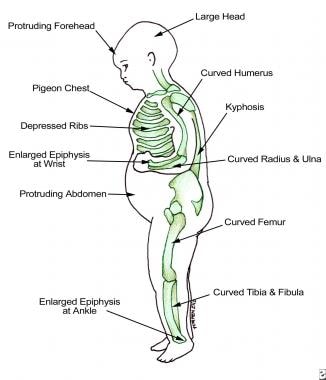
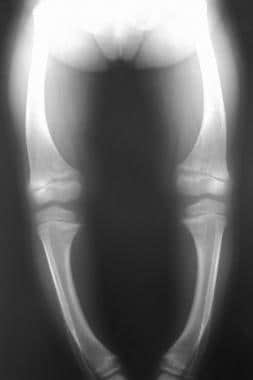
Synonyms, Key Words, and Related Terms: infantile osteomalacia, juvenile osteomalacia, rachitis, vitamin D deficiency, skeletal deformity, growth disturbance, hypocalcemia, tetany, rickets, osteoid, nutritional rickets, craniotabes, familial hypophosphatemia rickets, failure of osteoid to calcify, environmental pollution, muscular hypotonia, frontal bossing, delayed closing of anterior fontanelle, knobby deformity, rachitic rosary, Harrison groove, pigeon-breast deformity, kyphoscoliosis, Marfan sign, greenstick fracture, bowlegs, knock-knees, tetany, dietary deficiency of calcium, dietary deficiency of phosphorus, vitamin D-2, ergosterol
Author Information | Introduction | Clinical | Differentials | Workup | Treatment | Medication | Follow-up | Miscellaneous | Test Questions | Bibliography

AUTHOR INFORMATION Section 1 of 11    Click here to go to the top of this page Click here to go to the next section in this topic

Authored by Laurence Finberg, MD, Clinical Professor, Department of Pediatrics, University of California at San Francisco and Stanford University

Laurence Finberg, MD, is a member of the following medical societies: American Medical Association

Edited by Steven M Schwarz, MD, FAAP, FACN, Chair, Department of Pediatrics, Long Island College Hospital; Professor of Pediatrics, State University of New York, Downstate Medical Center College of Medicine; Mary L Windle, PharmD, Adjunct Assistant Professor, University of Nebraska Medical Center College of Pharmacy, Pharmacy Editor, eMedicine.com, Inc; Jatinder Bhatia, MD, Professor of Pediatrics, Chief, Section of Neonatology, Vice Chairman for Clinical Research, Department of Pediatrics, Medical College of Georgia; Merrily P M Poth, MD, Professor, Department of Pediatrics and Neuroscience, Uniformed Services University of the Health Sciences; and Jatinder Bhatia, MD, Professor of Pediatrics, Chief, Section of Neonatology, Vice Chairman for Clinical Research, Department of Pediatrics, Medical College of Georgia

Author's Email:Laurence Finberg, MDClick here to view conflict-of-interest information on the author of this topic
Editor's Email:Steven M Schwarz, MD, FAAP, FACN 

eMedicine Journal, April 25 2006, VOLUME 7, Number 4
INTRODUCTION Section 2 of 11   Click here to go to the next section in this topic Click here to go to the top of this page Click here to go to the next section in this topic

Background: Rickets is defined as the failure of osteoid to calcify in a growing person or animal. Failure of osteoid to calcify in the adult is called osteomalacia. Rickets occurs when the metabolites of vitamin D are deficient. Less commonly, dietary deficiency of calcium or phosphorus may produce rickets. Vitamin D (cholecalciferol [vitamin D-3], a steroid compound) is formed in the skin under the stimulus of ultraviolet light. Ultraviolet light was the only significant source of vitamin D until early in the 20th century when ergosterol (vitamin D-2), contained in fish liver oil or as an irradiated plant steroid, was discovered. Ergosterol can be taken orally with good effect.

Rickets appeared in epidemic form in temperate zones when the factories of the Industrial Revolution produced so much smoke that ultraviolet rays were blocked. Rickets was probably the first childhood disease caused by environmental pollution. At that point in history, the deficiency of sunlight could be said to have caused the rickets epidemic in industrial areas.

Human milk provides little vitamin D because of evolutionary forces not producing a need for vitamin D in tropical and other sunny climates. Infants and children at risk for rickets are those who are breastfed, those who receive no oral supplementation, and those with darkly pigmented skin, which blocks penetration of light. Living in an inner-city area also is a risk factor for rickets because of the presence of smog, which reduces the amount of ultraviolet radiation that reaches the residents.

Pathophysiology: Cholecalciferol (ie, vitamin D-3) is formed in the skin from 5-dihydrotachysterol. Alternatively, vitamin D-3 or vitamin D-2 may be ingested as fish liver oil or irradiated ergosterol from plant sources. This steroid undergoes hydroxylation in 2 steps. The first step occurs at position 25 in the liver, producing calcidiol (25-hydroxycholecalciferol), which is the circulating reserve compound. The second step occurs in the kidney at the 1 position, where it undergoes hydroxylation to the active metabolite calcitriol (1,25-dihydroxycholecalciferol), a hormone.

Calcitriol acts at 3 known sites. Calcitriol promotes absorption of calcium and phosphorous from the intestine, increases reabsorption of phosphate in the kidney, and acts on bone to release calcium and phosphate. Calcitriol may also directly facilitate calcification. These actions increase the concentrations of calcium and phosphate in extracellular fluid. The increase of calcium and phosphate in extracellular fluid, in turn, leads to the calcification of osteoid, primarily at the metaphyseal growing ends of bones but also throughout all osteoid in the skeleton. Parathyroid hormone facilitates the 1-hydroxylation step in vitamin D metabolism and, along with calcitriol and calcitonin, plays a role in calcium regulation.

When calcitriol levels are low, hypocalcemia develops, which stimulates parathyroid hormone excess. Excess parathyroid hormone, in turn, produces renal phosphate loss, further reducing calcification potential. Excess parathyroid hormone also produces changes in the bone similar to those occurring in hyperparathyroidism. Early in the course of rickets, the calcium concentration in the serum decreases. After the parathyroid response, the calcium concentration returns to the reference range, with a very low phosphate level. Alkaline phosphatase, which is produced by very active osteoblast cells, leaks to the extracellular fluids so that its concentration rises to anywhere from moderate elevation to very high levels.

Severe intestinal malabsorption and diseases of the liver or kidney may produce the clinical and secondary biochemical picture of nutritional rickets. The anticonvulsant drugs phenobarbital and phenytoin accelerate metabolism of calcidiol, which may lead to insufficiency and rickets, particularly in children who are kept indoors in institutions.

Calcium and vitamin D intakes are low in infants who are fed macrobiotic diets, and rickets often has been reported.

Frequency:

Mortality/Morbidity: Skeletal deformity and short stature may occur. Severe rickets causing pelvic distortion in women may preclude vaginal delivery.

Age: By definition, rickets is observed only during growth, although the effects may be observed later.
CLINICAL Section 3 of 11   Click here to go to the next section in this topic Click here to go to the top of this page Click here to go to the next section in this topic

History:

Causes: Rickets is caused by the failure of osteoid to calcify in the growing person or animal. Failure of osteoid to calcify in the adult is called osteomalacia. Rickets occurs when the metabolites of vitamin D are deficient. Less commonly, dietary deficiency of calcium or phosphorus may produce rickets. Vitamin D (cholecalciferol [vitamin D-3], a steroid compound) is formed in the skin under the stimulus of ultraviolet light. Ultraviolet light was the only significant source of vitamin D until early in the twentieth century, when ergosterol (vitamin D-2), which is contained in fish liver oil or as an irradiated plant steroid, was discovered. Ergosterol can be taken orally with good effect.
DIFFERENTIALS Section 4 of 11   Click here to go to the next section in this topic Click here to go to the top of this page Click here to go to the next section in this topic

[Metabolic Bone Disease]


WORKUP Section 5 of 11   Click here to go to the next section in this topic Click here to go to the top of this page Click here to go to the next section in this topic

Lab Studies:

Imaging Studies:

TREATMENT Section 6 of 11   Click here to go to the next section in this topic Click here to go to the top of this page Click here to go to the next section in this topic

Medical Care: Adequate ultraviolet light or 10 mcg (400 U) PO daily of a vitamin D preparation and an adequate dietary supply of calcium and phosphorus prevent rickets. As little as 20 min/d of ultraviolet light to the face of a light-skinned baby is sufficient; however, significantly longer periods of exposure are necessary for children with melanotic skin.

MEDICATION Section 7 of 11   Click here to go to the next section in this topic Click here to go to the top of this page Click here to go to the next section in this topic

Drug Category: Vitamin D -- Fat-soluble vitamin used to treat vitamin D deficiency or for prophylaxis of deficiency.
Drug Name
Cholecalciferol (Delta-D) -- Vitamin D-3. 1 mg provides 40,000 IU vitamin D activity.
Pediatric DoseSingle-day dose method: 15,000 mcg (600,000 U) PO qd divided in 4-6 doses for 1 d
Gradual method: 125-250 mcg (5000-10,000 U) qd for 2-3 mo
ContraindicationsDocumented hypersensitivity; hypercalcemia; malabsorption syndrome; decreased renal function
InteractionsCholestyramine and colestipol decrease absorption of calcitriol; magnesium-containing antacids and thiazide diuretics can increase effects; poor absorption of vitamin D (and all fat-soluble vitamins) may be associated with administration of mineral oil–containing laxatives
Pregnancy C - Safety for use during pregnancy has not been established.
PrecautionsAdequate response depends on adequate dietary calcium intake; maintain adequate fluid intake
FOLLOW-UP Section 8 of 11   Click here to go to the next section in this topic Click here to go to the top of this page Click here to go to the next section in this topic

Complications:

MISCELLANEOUS Section 9 of 11   Click here to go to the next section in this topic Click here to go to the top of this page Click here to go to the next section in this topic

Medical/Legal Pitfalls:

TEST QUESTIONS Section 10 of 11   Click here to go to the next section in this topic Click here to go to the top of this page Click here to go to the next section in this topic

CME Question 1: Which if the following is the active metabolite of vitamin D?


A: Cholecalciferol
B: Dihydrotachysterol
C: Calcitriol
D: Calcidiol
E: 7-Dehyrocholesterol

The correct answer is C: Calcitriol is the active metabolite and the hormone derived from cholecalciferol by 2 oxidation steps. Some of the intermediates and molecules of further oxidation have less activity.

CME Question 2: Which of the following tissues is not involved in vitamin D metabolism?


A: Liver
B: Skin
C: Kidney
D: Thyroid
E: Parathyroid

The correct answer is D: Each of the organs except the thyroid participates in producing the active metabolite. Cholecalciferol (ie, vitamin D-3) is formed in the skin from 5-dihydrotachysterol. Alternatively, vitamin D-3 or vitamin D-2 may be ingested as fish liver oil or irradiated ergosterol from plant sources. This steroid undergoes hydroxylation in 2 steps. The first step occurs at position 25 in the liver, producing calcidiol (25-hydroxycholecalciferol), which is the circulating reserve compound. The second step occurs in the kidney at the 1 position, where it undergoes hydroxylation to the active metabolite calcitriol (1,25-dihydroxycholecalciferol), a hormone. When calcitriol levels are low, hypocalcemia develops, which stimulates parathyroid hormone excess.

Pearl Question 1 (T/F): Human milk from a well-nourished woman has adequate vitamin D.

The correct answer is False: Human milk (and animal milk in general) contains only minute amounts of vitamin D because of evolutionary forces not producing a need for vitamin D in tropical and other sunny climates. Infants and children at risk for rickets are those who are breastfed, those who receive no oral supplement, and those with darkly pigmented skin, which blocks penetration of ultraviolet light (a significant source of vitamin D). Living in an inner-city area also is a risk factor for rickets because of the presence of smog, which reduces the amount of ultraviolet radiation that reaches the residents.

Pearl Question 2 (T/F): Vitamin D is converted to its active metabolite in the intestine.

The correct answer is False: Conversion occurs in 2 steps. The first step occurs at position 25 in the liver, producing calcidiol (25-hydroxycholecalciferol), which is the circulating reserve compound. The second step occurs in the kidney at the 1 position, where it undergoes hydroxylation to the active metabolite calcitriol (1,25-dihydroxycholecalciferol), a hormone.

Pearl Question 3 (T/F): Living in an inner-city area increases an infant’s risk of rickets.

The correct answer is True: The smog, which is characteristic of urban areas, reduces ultraviolet radiation to residents. Vitamin D supplementation is critically important for infants living in an inner-city area.

Pearl Question 4 (T/F): A physical sign of rickets is the sensation of a double malleolus on palpation.

The correct answer is True: This also is known as the Marfan sign. Because the softened long bones may bend, they may fracture one side of the cortex (ie, greenstick fracture).
BIBLIOGRAPHY Section 11 of 11   Click here to go to the next section in this topic Click here to go to the top of this page

NOTE:
Medicine is a constantly changing science and not all therapies are clearly established. New research changes drug and treatment therapies daily. The authors, editors, and publisher of this journal have used their best efforts to provide information that is up-to-date and accurate and is generally accepted within medical standards at the time of publication. However, as medical science is constantly changing and human error is always possible, the authors, editors, and publisher or any other party involved with the publication of this article do not warrant the information in this article is accurate or complete, nor are they responsible for omissions or errors in the article or for the results of using this information. The reader should confirm the information in this article from other sources prior to use. In particular, all drug doses, indications, and contraindications should be confirmed in the package insert. FULL DISCLAIMER
eMedicine Journal, April 25 2006, VOLUME 7, Number 4
© Copyright 2001, eMedicine.com, Inc.

eMedicine Journals > Pediatrics > Nutrition > Rickets
Please email us with any comments you have on our new chapter format.
 
Use the our online Merriam-Webster medical dictionary.