|
|
|
eMedicine Journal
>
Emergency Medicine
>
Environmental
Snake Envenomations, Coral Synonyms, Key Words, and Related Terms: snakebite, snake bite, coral snake, Elapidae, Micrurus fulvius, eastern coral snake, Micrurus tener, Texas coral snake, coral snake envenomations, coral snake bite, Micruroides euryxanthus, Sonoran coral snake, Arizona coral snake |
||||||||||
|
Author Information | Introduction | Clinical | Differentials | Workup | Treatment | Medication | Follow-up | Miscellaneous | Test Questions | Pictures | Bibliography
|
| AUTHOR INFORMATION | Section 1 of 12 |
Authored by Robert Norris, MD, Chief, Associate Professor, Department of Surgery, Division of Emergency Medicine, Stanford University Medical Center
Robert Norris, MD, is a member of the following medical societies: American College of Emergency Physicians, American Medical Association, California Medical Association, and Wilderness Medical Society
Edited by Edmond Hooker, MD, Assistant Clinical Professor, Department of Emergency Medicine, University of Louisville, Wright State University; John T VanDeVoort, PharmD, Clinical Assistant Professor, College of Pharmacy, University of Minnesota; David Eitel, MD, MBA, Associate Professor, Department of Emergency Medicine, York Hospital; John Halamka, MD, Chief Information Officer, CareGroup Healthcare System, Assistant Professor of Medicine, Department of Emergency Medicine, Beth Israel Deaconess Medical Center; Assistant Professor of Medicine, Harvard Medical School; and Jonathan Adler, MD, Attending Physician, Department of Emergency Medicine, Massachusetts General Hospital; Division of Emergency Medicine, Harvard Medical School
| Author's Email: | Robert Norris, MD | |
|---|---|---|
| Editor's Email: | Edmond Hooker, MD |
eMedicine Journal, January 4 2007, VOLUME 8,
Number 1
| INTRODUCTION | Section 2 of 12 |
Background: Approximately 40-50 species of venomous coral snakes exist in North and South America, with the greatest variety from Mexico to northern South America. A number of African and Asian coral snake species also exist. All coral snakes belong to the family Elapidae; Micrurus fulvius (eastern coral snake) and Micrurus tener (Texas coral snake) are the most important species in the United States.
Another US coral snake is Micruroides euryxanthus (Sonoran or Arizona coral snake); but this is a relatively innocuous snake, and no deaths have been attributed to its bite.
Coral snakes tend to be relatively shy creatures, and bites are uncommon. Coral snakes account for fewer than 1% of venomous snakebites in the United States. Most people bitten by coral snakes are handling them intentionally. Most bites occur in the spring or fall.
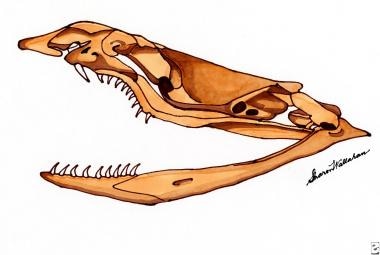
Pathophysiology: The coral snake venom apparatus is composed of a pair of small, fixed, hollow fangs in the anterior aspect of the upper jaw through which the snake conducts venom via a chewing motion (see Image 2). Unlike pit vipers, such as rattlesnakes, copperheads, and cottonmouths, which strike quickly, coral snakes must hang on for a brief period to achieve significant envenomation in humans.
Coral snake venoms tend to have significant neurotoxicity, inducing neuromuscular dysfunction. They have little enzymatic activity or necrotic potential compared to most vipers and pit vipers. These venoms tend to be some of the most potent found in snakes, yet the venom yield per animal is less than that of most vipers or pit vipers. Because of the relatively primitive venom delivery apparatus, as many as 60% of those bitten by North American coral snakes are not envenomed.
Frequency:
Mortality/Morbidity: No deaths related to coral snake bites have been reported in the United States since coral snake antivenom became available. Before that time, the estimated case fatality rate was 10%, and the cause of death was respiratory or cardiovascular failure. Patients who survive the bite may require respiratory support for up to a week and may suffer persistent weakness for weeks to months.
| CLINICAL | Section 3 of 12 |
History:
Physical:
| DIFFERENTIALS | Section 4 of 12 |
Snake Envenomations, Brown
Snake Envenomations, Cobra
Snake Envenomations, Moccasins
Snake Envenomations, Mohave Rattle
Snake Envenomations, Rattle
Snake Envenomations, Sea
| WORKUP | Section 5 of 12 |
Lab Studies:
Imaging Studies:
| TREATMENT | Section 6 of 12 |
Prehospital Care: Of utmost importance is prompt movement of the victim to a medical facility capable of rendering advanced care, including possible antivenom administration and airway support.
Emergency Department Care:
Consultations:
| MEDICATION | Section 7 of 12 |
| Drug Name | Micrurus fulvius Antivenin -- DOC for significant bites by M fulvius (eastern coral snake) and M tener (Texas coral snake). Manufacturer generally recommends skin testing for potential acute sensitivity. However, such testing is not a reliable predictor of anaphylactoid reactions. If the patient is in extremis, antivenom should be started while closely monitoring for adverse reactions. Before administration, the patient's IV volume should be expanded using crystalloid solutions (eg, NS) unless contraindication exists (eg, presence of congestive heart failure). Pretreat with antihistamines (H1 and H2 blockers, see antihistamines below). Epinephrine should be immediately available for treatment of an allergic response to heterologous serum. Wyeth-Ayerst product comes in a lyophilized state and must be reconstituted before administration. This is best accomplished by instilling 10 mL warm diluent (NS) into each vial and gently agitating under warm running tap water. Then, the starting dose is diluted in 500-1000 mL of crystalloid (this volume may need to be reduced in children) and should be initiated at a slow rate with physician in immediate attendance. If no reaction occurs, rate should be increased gradually to administer full starting dose in 1-2 h. If acute reaction occurs, antivenom should be halted and the patient treated prn with epinephrine, antihistamines, and steroids. Then, antivenom can usually be restarted at a slower rate or in a more dilute form. If reaction persists or is severe, the physician may need to rely solely on sound supportive care for the patient. |
|---|---|
| Adult Dose | Initial: 3-6 vials IV over 1-2 h; if signs or symptoms continue to progress, administer an additional 3-5 vials over 1-2 h; rarely are more than 10 vials required |
| Pediatric Dose | Administer as in adults; total volume of diluent should be appropriately reduced depending on child's size and hemodynamic status |
| Contraindications | Documented hypersensitivity; may be indicated for severe envenomation despite allergy |
| Interactions | None reported |
| Pregnancy | C - Safety for use during pregnancy has not been established. |
| Precautions | Anaphylactic/anaphylactoid reactions and delayed serum sickness are a concern; appropriate therapeutic agents for anaphylaxis treatment should be ready for immediate use; while use in pregnancy has not been well studied, it is generally felt that the benefits of antivenom administration outweigh the risks |
| Drug Name | Diphenhydramine (Benadryl) -- Administered parenterally and often is the H1 blocker of choice in treating or preventing anaphylactic/anaphylactoid reactions. Also effective in oral form for treating itching associated with serum sickness. |
|---|---|
| Adult Dose | Pretreatment for antivenom: 1 mg/kg/dose IV; not to exceed 100 mg/dose; if acute allergic reaction subsequently occurs, additional doses may be required; not to exceed 300 mg/d Serum sickness: 1 mg/kg PO q6h prn itching; not to exceed 400 mg/d |
| Pediatric Dose | Pretreatment for antivenom: Administer as in adults Serum sickness: 1 mg/kg PO q6h prn itching; not to exceed 300 mg/d |
| Contraindications | Documented hypersensitivity; MAOIs |
| Interactions | Potentiates effect of CNS depressants; because of alcohol content, do not give syrup dosage form to patient taking medications that can cause disulfiramlike reactions |
| Pregnancy | C - Safety for use during pregnancy has not been established. |
| Precautions | May exacerbate angle closure glaucoma, hyperthyroidism, peptic ulcer, and urinary tract obstruction |
| Drug Name | Cimetidine (Tagamet) -- Administered parenterally and often is the H2 blocker of choice in treating or preventing anaphylactoid reactions. Use this medication in addition to H1 antihistamines. |
|---|---|
| Adult Dose | 300 mg IV q6h prn |
| Pediatric Dose | 5-10 mg/kg IV q6h prn; not to exceed 300 mg/dose |
| Contraindications | Documented hypersensitivity |
| Interactions | Can increase blood levels of theophylline, warfarin, tricyclic antidepressants, triamterene, phenytoin, quinidine, propranolol, metronidazole, procainamide, and lidocaine |
| Pregnancy | B - Usually safe but benefits must outweigh the risks. |
| Precautions | Elderly persons may experience confusional states; may cause impotence and gynecomastia in young males; may increase levels of many drugs; adjust dose or discontinue treatment if changes in renal function occur |
| Drug Name | Epinephrine (EpiPen, Adrenaline) -- DOC for treating anaphylactoid reactions. Has alpha-agonist effects that increase peripheral vascular resistance and reverse peripheral vasodilatation, systemic hypotension, and vascular permeability. Conversely, beta-agonist activity of epinephrine produces bronchodilatation, chronotropic cardiac activity, and positive inotropic effects. |
|---|---|
| Adult Dose | 0.01 mL/kg of 1:1000 (1 mg/mL) IM/SC; not to exceed 0.5 mL |
| Pediatric Dose | 0.01 mL/kg of 1:1000 (1 mg/mL) IM/SC; not to exceed 0.3 mL; may be repeated q10-20min prn For severe hypotension: 0.05 mcg/kg/min IV initially (ie, 1 mg in 500 mL isotonic saline, starting at 0.025 mL/kg/min); titrate to effect |
| Contraindications | Documented hypersensitivity; cardiac dysrhythmias or angle-closure glaucoma; do not use during labor (may delay second stage of labor) |
| Interactions | Concurrent use with alpha- or beta-blockers is not recommended; nonselective beta blockade allows alpha-receptor effects to predominate; increasing vascular resistance leads to increased BP and reflex bradycardia; closely monitor vital signs if the patient is taking a beta-blocker; pressor action is increased when coadministered with alpha agonists; increases toxicity of halogenated inhalational anesthetics |
| Pregnancy | B - Usually safe but benefits must outweigh the risks. |
| Precautions | Caution in elderly persons, prostatic hypertrophy, hypertension, cardiovascular disease, diabetes mellitus, hyperthyroidism, and cerebrovascular insufficiency; rapid IV infusions may cause death from cerebrovascular hemorrhage or cardiac dysrhythmias |
| Drug Name | Dopamine (Intropin) -- May be required to support BP with hypotension caused by anaphylactoid reaction that is unresponsive to fluids and epinephrine or by direct coral snake venom effects that are unresponsive to fluids and antivenom. |
|---|---|
| Adult Dose | 5-20 mcg/kg/min IV; titrate to effect |
| Pediatric Dose | Administer as in adults |
| Contraindications | Documented hypersensitivity; pheochromocytoma; ventricular fibrillation |
| Interactions | Phenytoin, alpha-adrenergic and beta-adrenergic blockers, general anesthesia, and MAOIs increase and prolong the effects |
| Pregnancy | C - Safety for use during pregnancy has not been established. |
| Precautions | Monitor closely urine flow, cardiac output, pulmonary wedge pressure, and BP during infusion; prior to infusion, correct hypovolemia as indicated; monitoring central venous pressure or left ventricular filling pressure may be helpful in detecting and treating hypovolemia |
| Drug Name | Norepinephrine (Levophed) -- May be used as alternative to dopamine to support BP in the face of hypotension caused by anaphylactoid reaction unresponsive to fluids and epinephrine. |
|---|---|
| Adult Dose | 0.5-1 mcg/min IV; titrate to effect |
| Pediatric Dose | 0.1 mcg/kg/min IV; titrate to effect |
| Contraindications | Documented hypersensitivity; peripheral or mesenteric vascular thrombosis because ischemia may be increased and area of infarct extended |
| Interactions | Atropine may enhance pressor response by blocking reflex bradycardia |
| Pregnancy | D - Unsafe in pregnancy |
| Precautions | If possible, correct intravascular volume depletion before therapy; extravasation may cause severe tissue necrosis and, thus, should be administered into a large vein; caution in occlusive vascular disease |
| Drug Name | Methylprednisolone (Solu-Medrol, Adlone) -- Ameliorates the delayed effects of anaphylactoid reactions and may prevent biphasic anaphylaxis. In severe cases of serum sickness, parenteral steroids may reduce the inflammatory effects of this immune-complex mediated disease. |
|---|---|
| Adult Dose | 125 mg IV q6-8h |
| Pediatric Dose | 1-2 mg/kg IV q6-8h |
| Contraindications | Documented hypersensitivity; viral, fungal, or tubercular skin infections |
| Interactions | Coadministration with digoxin may increase digitalis toxicity secondary to hypokalemia; estrogens may increase levels; phenobarbital, phenytoin, and rifampin may decrease levels (adjust dose); monitor patients for hypokalemia when taking medication concurrently with diuretics |
| Pregnancy | C - Safety for use during pregnancy has not been established. |
| Precautions | Hyperglycemia, edema, osteonecrosis, peptic ulcer disease, hypokalemia, osteoporosis, euphoria, psychosis, growth suppression, myopathy, and infections are possible complications of glucocorticoid use |
| Drug Name | Prednisone (Deltasone) -- This or other PO forms of corticosteroids (eg, prednisolone) are useful in managing mild-to-moderate serum sickness on an outpatient basis. |
|---|---|
| Adult Dose | 1 mg/kg PO qd until symptoms resolve; taper over 1-2 wk |
| Pediatric Dose | Administer as in adults |
| Contraindications | Documented hypersensitivity; viral infection; peptic ulcer disease; hepatic dysfunction; connective tissue infections; fungal or tubercular skin infections |
| Interactions | Coadministration with estrogens may decrease clearance; concurrent use with digoxin may cause digitalis toxicity secondary to hypokalemia; phenobarbital, phenytoin, and rifampin may increase metabolism of glucocorticoids (consider increasing maintenance dose); monitor for hypokalemia with coadministration of diuretics |
| Pregnancy | B - Usually safe but benefits must outweigh the risks. |
| Precautions | Abrupt discontinuation of glucocorticoids after long-term therapy may cause adrenal crisis; hyperglycemia, edema, osteonecrosis, myopathy, peptic ulcer disease, hypokalemia, osteoporosis, euphoria, psychosis, myasthenia gravis, growth suppression, and infections may occur with glucocorticoid use |
| Drug Name | Tetanus immune globulin (Hyper-Tet) -- Used for passive immunization if wound might be contaminated with tetanus spores when the patient has no history of completing a primary tetanus immunization series. |
|---|---|
| Adult Dose | Prophylaxis: 250-500 U IM in different anatomical site than tetanus toxoid administration Clinical tetanus: 3000-10,000 U IM |
| Pediatric Dose | Prophylaxis: 250 U IM in different anatomical site than tetanus toxoid administration Clinical tetanus: Administer as in adults |
| Contraindications | Since antibodies in globulin preparation may interfere with immune response to vaccination, do not administer within 3 mo of live virus immune globulin administration; may be necessary to revaccinate persons who received immune globulin shortly after live virus vaccination |
| Interactions | None reported |
| Pregnancy | C - Safety for use during pregnancy has not been established. |
| Precautions | Persons with isolated immunoglobulin A (IgA) deficiency have potential for developing antibodies to IgA and could have anaphylactic reactions to subsequent administration of blood products that contain IgA; do not perform skin testing since intradermal injection of concentrated gamma globulin may cause localized area of inflammation and can be misinterpreted, causing the medication to be withheld from a patient not allergic to this material; true allergic responses to human gamma globulin given in prescribed IM manner are extremely rare; do not admix with other medications since usually incompatible |
| Drug Name | Tetanus toxoid -- The immunizing agent of choice for most adults and children > 7 y is tetanus and diphtheria toxoids. Necessary to administer booster doses to maintain tetanus immunity throughout life. Pregnant patients should receive only tetanus toxoid, not a diphtheria antigen-containing product. In children and adults, may administer into deltoid or midlateral thigh muscles. In infants, preferred site of administration is the mid-thigh laterally. |
|---|---|
| Adult Dose | Suggested dosing: Primary immunization: 0.5 mL IM, give 2 injections 4-8 wk apart and a third dose 6-12 mo after second injection Booster dose: 0.5 mL q 10 y |
| Pediatric Dose | Administer as in adults |
| Contraindications | Documented hypersensitivity; a history of any type of neurological symptoms or signs following administration of this product; FDA recommends that elective tetanus immunization be deferred during any outbreak of poliomyelitis because tetanus toxoid injections are an important cause of provocative poliomyelitis |
| Interactions | Patients receiving immunosuppressants, including corticosteroids or radiation therapy, may remain susceptible despite immunization due to poor immune response; cimetidine may enhance or augment delayed-hypersensitivity responses to skin-test antigens; avoid concurrent use of medication with systemic chloramphenicol since it may impair amnestic response to tetanus toxoid; concurrent use of tetanus immune globulin may delay development of active immunity by several days (interaction is nevertheless clinically insignificant and does not preclude its concurrent use) |
| Pregnancy | C - Safety for use during pregnancy has not been established. |
| Precautions | Do not use to treat actual tetanus infections, or for immediate prophylaxis of unimmunized individuals (use instead tetanus antitoxin, preferably human tetanus immune globulin) diminished antibody response to active immunization may be seen in patients receiving immunosuppressive therapy; better to defer primary diphtheria immunization until immunosuppressive therapy discontinued; routine immunization of symptomatic and asymptomatic HIV-infected persons is recommended |
| FOLLOW-UP | Section 8 of 12 |
Further Inpatient Care:
Deterrence/Prevention:
Complications:
Prognosis:
Patient Education:
| MISCELLANEOUS | Section 9 of 12 |
Medical/Legal Pitfalls:
Special Concerns:
| TEST QUESTIONS | Section 10 of 12 |
CME Question 1: Which of the following statements regarding coral snakes is true?
A: They can be reliably identified throughout their range by a contiguous red and yellow banding pattern.
B: Most bites occur in individuals who are unaware of a nearby snake.
C: They tend to be shy and reclusive.
D: They have a sophisticated venom delivery apparatus with long, retractable, anterior fangs.
E: None of the above
The correct answer is C: Coral snakes are generally shy and reclusive creatures, which explains the small number of bites reported in the United States each year. South of Mexico City, the color pattern can be misleading as a guide to identification. Because of their relatively inefficient venom delivery apparatus (ie, small fixed anterior fangs), coral snakes generally have difficulty envenomating unless they are touched or handled.
CME Question 2: Which of the following statements regarding the management of coral snake bites is true?
A: Asymptomatic patients can be safely discharged after 4 hours of observation.
B: Pit viper antivenom can effectively neutralize the venom of most coral snakes.
C: Patients should be administered sedative agents liberally.
D: Prophylactic antibiotics generally are unnecessary.
E: None of the above
The correct answer is D: Because of the relative paucity of enzymatic necrotic components in their venoms, coral snake bites tend to cause little local tissue damage and secondary infections are rare. Admit all persons bitten by a coral snake in order to watch for delayed onset of signs and symptoms. Pit viper antivenom is of no benefit in coral snake bites. Sedatives must be used cautiously in these patients because of the risk of respiratory depression.
Pearl Question 1 (T/F): Respiratory arrest is the most significant risk to life following coral snake envenomation.
The correct answer is True: Historically, death related to coral snake bite has been related to respiratory and cardiovascular failure.
Pearl Question 2 (T/F): In the United States, a red-on-yellow band color pattern is reliable in identifying a snake as a coral snake.
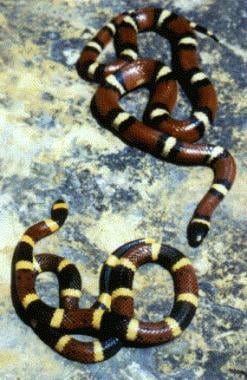
The correct answer is True: A pattern of red, yellow, black, yellow, red bands (red and yellow bands contiguous) reliably identifies coral snakes in the United States. A helpful hint is to remember the warning colors on a traffic light: red and yellow. When these two colors touch on a snake in the United States, a strong possibility exists that it is a dangerous coral snake.
Pearl Question 3 (T/F): Pressure immobilization may be a worthwhile first aid technique following a coral snake bite.
The correct answer is True: The pressure immobilization technique (starting distally, wrapping with materials, such as an elastic bandage or long strip of cloth, and working up the entire limb), combined with a splint, has been demonstrated to significantly limit and delay the spread of elapid snake venoms, including coral snake venom. Wrap the extremity as tightly as for a severely sprained ankle.
Pearl Question 4 (T/F): Antivenin (Micrurus fulvius), produced by Wyeth-Ayerst Labs, is indicated for bites by all coral snake species native to the United States.
The correct answer is False: Antivenin (M fulvius) provides coverage for the eastern and the Texas coral snakes. Its value in treating Sonoran coral snake bites is uncertain, but these bites tend to be very mild and can be managed with supportive care alone.
| PICTURES | Section 11 of 12 |
| Caption: Picture 1. Snake envenomations, coral. Comparison of the harmless Lampropeltis triangulum annulata (Mexican milksnake) (top) with Micrurus tener (Texas coral snake) (bottom). Photo by Charles Alfaro. | |
![]() | View Full Size Image |
eMedicine Zoom View (Interactive!) | |
| Picture Type: Photo | |
| Caption: Picture 2. Coral snake skull. | |
![]() | View Full Size Image |
eMedicine Zoom View (Interactive!) | |
| Picture Type: Image | |
Caption: Picture 3. The Australian pressure-immobilization technique for field management of elapid snakebite. This technique may be useful in coral snake bites, but it has never been formally evaluated.
See Image 4 for Figures 4-6.
| |
![]() | View Full Size Image |
eMedicine Zoom View (Interactive!) | |
| Picture Type: Image | |
Caption: Picture 4. The Australian pressure-immobilization technique for field management of elapid snakebite. This technique may be useful in coral snake bites, but it has never been formally evaluated. See Image 3 for Figures 1-3.
| |
![]() | View Full Size Image |
eMedicine Zoom View (Interactive!) | |
| Picture Type: Image | |
| BIBLIOGRAPHY | Section 12 of 12 |
| NOTE: |
|---|
| Medicine is a constantly changing science and not all therapies are clearly established. New research changes drug and treatment therapies daily. The authors, editors, and publisher of this journal have used their best efforts to provide information that is up-to-date and accurate and is generally accepted within medical standards at the time of publication. However, as medical science is constantly changing and human error is always possible, the authors, editors, and publisher or any other party involved with the publication of this article do not warrant the information in this article is accurate or complete, nor are they responsible for omissions or errors in the article or for the results of using this information. The reader should confirm the information in this article from other sources prior to use. In particular, all drug doses, indications, and contraindications should be confirmed in the package insert. FULL DISCLAIMER |
| eMedicine Journals > Emergency Medicine > Environmental > Snake Envenomations, Coral |
| Please email us with any comments you have on our new chapter format. |
|
Author Information | Introduction | Clinical | Differentials | Workup | Treatment | Medication | Follow-up | Miscellaneous | Test Questions | Pictures | Bibliography
|
|